
- Messages
- 178
- Classified ads
- 1
Part of the reason I went into syndications as an LP, although that has its own set of hurdles and drawbacks.I would rather boil my balls in oil than be a landlord in California.
By clicking Enter, you confirm you are 18 years of age or older and agree to comply with all applicable local, state, and federal laws.
Notice: Any content or member activity - including anything you may buy, sell, transfer, or discuss - must comply with current and upcoming laws.
Members are encouraged to stay informed: California Firearm Laws: 2026 Outlook & 2025 Recap . Responsibility for compliance rests solely with the individual member.

Welcome to CAguns.net!
Join our growing community where you can ask questions, share knowledge, or browse our classifieds section.
Sign up for a free account today and unlock full access! Once registered, you can search, post, and take advantage of exclusive features unavailable to guests.
A note on why more of the site now requires an account: automated scrapers and AI systems have been crawling our forums and classifieds at a scale. Requiring sign-in for those sections is the most effective tool we have. It takes a minute to register, it's free, and it keeps what happens here between actual members.
New to California gun ownership or trying to keep up with the changing laws? Check out our sister site CA2A.com — free courses, plain-English legal updates, and step-by-step guides built for California owners.
Advanced features are available only to registered members. Register today!

Part of the reason I went into syndications as an LP, although that has its own set of hurdles and drawbacks.I would rather boil my balls in oil than be a landlord in California.
I'm not 100% sure I understand, so sorry if this first bit is pedantic... The government can't cut spending - I know they say that is what they're doing, but they're not actually. Take a look at the 'debt to the penny' chart from the Treasury below (link here); Federal spending has increased pace by ~100% over the past couple of months despite DOGE and other [illegal] RIF attempts. The Treasury will continue to sell bonds to cover these costs and push the Federal Reserve to lower overnight rates and print money by revaluing gold, forcing bond purchases to implement crypto, etc. Here's the 2025 budget breakdown (link) - Medicare, other healthcare spending, and social security (which is complicated because it has a designated tax revenue stream) make up approximately half of the total budget. It's not politically viable to cut social services spending, and so austerity is not possible. The ACA subsidies currently being debated in Congress constitute just $34B/yr out of a total of $980B/yr in non-Medicare healthcare spending. This is way way too small to meaningfully affect debt/GDP. Also, this spending goes back into the economy where it generates tax revenue... so cutting spending also has a negative impact on revenue and GDP growth, which is confusing AF.The problem I think I'm not seeing described in it is that the government's spending cycle will continue to grow regardless.
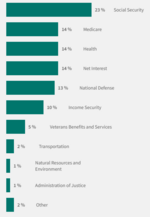
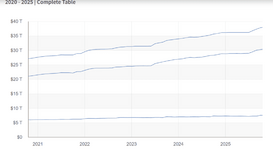

I'm not 100% sure I understand, so sorry if this first bit is pedantic... The government can't cut spending - I know they say that is what they're doing, but they're not actually. Take a look at the 'debt to the penny' chart from the Treasury below (link here); Federal spending has increased pace by ~100% over the past couple of months despite DOGE and other [illegal] RIF attempts. The Treasury will continue to sell bonds to cover these costs and push the Federal Reserve to lower overnight rates and print money by revaluing gold, forcing bond purchases to implement crypto, etc. Here's the 2025 budget breakdown (link) - Medicare, other healthcare spending, and social security (which is complicated because it has a designated tax revenue stream) make up approximately half of the total budget. It's not politically viable to cut social services spending, and so austerity is not possible. The ACA subsidies currently being debated in Congress constitute just $34B/yr out of a total of $980B/yr in non-Medicare healthcare spending. This is way way too small to meaningfully affect debt/GDP. Also, this spending goes back into the economy where it generates tax revenue... so cutting spending also has a negative impact on revenue and GDP growth, which is confusing AF.
I think you're suggesting that the government risks precipitating a fiscal crisis or debt spiral - the US economy is a cycle, but the Fed's role is to keep it under control. The Treasury sells bonds increasing the total debt burden and so interest takes a larger portion of the budget. But by forcing the Fed to print money, resulting in inflation, the Treasury expects to take in more tax revenue, which counteracts the increasing interest. What the Treasury wants to do - and has done in the past - is achieve economic repression whereby inflation outpaces real yields on treasuries, effectively pushing the federal debt onto the economy as a whole "without raising taxes" (it achieves the same thing without being called a tax). This is supposed to happen without collusion between the Fed and Treasury. If inflation gets too high, bond holders will demand higher interest rates or flee the dollar altogether. Some institutions like banks and crypto companies will be forced to hold Treasuries. Currently, the Fed only sets the overnight interest rate, but in more sever instability, they could implement yield curve control and buy unlimited amounts of bonds to force longer-term interest rates lower in order to stabilize the economy.
I don't personally trust Scott Bessent - failed hedge fund manager - to manage the federal debt responsibly. And if Trump et al stack the Federal Reserve Board of Governors, it will do a ton of damage to the dollar's reputation. But will the dollar collapse? I don't think so. Will the wealth gap widen? Yes, absolutely.
View attachment 105157
View attachment 105153

Well... I disagree - symbolically cutting spending is useless, and deep cuts aren't a good idea. In a macroeconomic sense, inflation and devaluation of the dollar is completely normal, even if painful for consumers. The federal government cannot balance the budget - it's both not possible and not desirable. Most of this administration's fiscal policies are increasing the budget deficit, which is not ideal either. The goal is not to pay down the federal debt... that would actually make things worse because it'd fundamentally be quantitative tightening and risks recession. Federal debt and federal economic policy aren't like personal debt and personal spending, because the government's bond buying and selling are the controls on the money supply; there's no real corollary in personal finance. If there was no federal debt, they would have no handles by which to control the economy.The government can cut spending, but they WILL not. Those are two different things.
Answer me this, what happens if a treasury auction doesn’t succeed and no one buys the treasuries?Well... I disagree - symbolically cutting spending is useless, and deep cuts aren't a good idea. In a macroeconomic sense, inflation and devaluation of the dollar is completely normal, even if painful for consumers. The federal government cannot balance the budget - it's both not possible and not desirable. Most of this administration's fiscal policies are increasing the budget deficit, which is not ideal either. The goal is not to pay down the federal debt... that would actually make things worse because it'd fundamentally be quantitative tightening and risks recession. Federal debt and federal economic policy aren't like personal debt and personal spending, because the government's bond buying and selling are the controls on the money supply; there's no real corollary in personal finance. If there was no federal debt, they would have no handles by which to control the economy.
At some level, the "economy" is an apparatus that the government uses to force people to work - which is depressing. But it has also allowed America to enjoy a higher standard of living compared to most of the world - which is good. The government's debt is - in part - used to buy our higher standard of living. It's a lousy proposition to ask Americans to give up the social safety net, which was largely implemented by Roosevelt to help us plebeians out of The Depression, because all it will do is enrich those at the top.
I don't think that's a plausible scenario, and we're definitely not there today. The main reason is that US bondholders are a pretty diverse group; 78% of the federal debt is held domestically, and the US still has an excellent credit rating and highly transparent central bank (for now!) compared to other countries around the world. The government itself is the largest bondholder (36%, including the Fed). Consider Social Security, for example - these moneys are 'invested' in two designated funds that primarily buy US treasuries, and this won't change (unless Trump succeeds in 'privatizing' SS so the funds buy securities instead). China only holds like 0.2% of the debt....if a treasury auction doesn’t succeed and no one buys the treasuries?
Then the 20k I keep there for a little side pot of emergency fund will be gone, and it will be the least of my worries because things will be far worse than that ultra depreciated 20 grand could help with anyway.Answer me this, what happens if a treasury auction doesn’t succeed and no one buys the treasuries?
I don't think that's a plausible scenario, and we're definitely not there today. The main reason is that US bondholders are a pretty diverse group; 78% of the federal debt is held domestically, and the US still has an excellent credit rating and highly transparent central bank (for now!) compared to other countries around the world. The government itself is the largest bondholder (36%, including the Fed). Consider Social Security, for example - these moneys are 'invested' in two designated funds that primarily buy US treasuries, and this won't change (unless Trump succeeds in 'privatizing' SS so the funds buy securities instead). China only holds like 0.2% of the debt.
The Treasury is currently buying back treasuries to maintain liquidity, but that's different than a fiscal crisis or default. The Treasury is buying its own debt to prop up bond sales - and it'll save money by rolling over long bonds into short-term treasuries.
So your question is in essence "what happens if America stop buying America's debt"... The debt will be bought, at some interest rate. Some buyers (like banks, crypto) will be forced to buy, some will continue to be foreign investors seeking safer storage of wealth, and others will be private individuals who don't know their 401(k) and money market account indirectly hold Treasury bonds.
Then the 20k I keep there for a little side pot of emergency fund will be gone, and it will be the least of my worries because things will be far worse than that ultra depreciated 20 grand could help with anyway.
Yes! They're accelerating the drop-dead date for Social Security, and I fully expect the wealth gap to widen. In an extreme scenario, low- to middle-income Americans will fall into poverty, life expectancy will fall again, and civil unrest or violence will rise.There's certainly a point where we print so much money that we inflate away everyone's savings and the value of these pensioners checks.
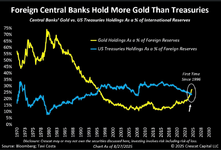
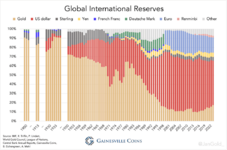
Here's another interesting visual of historical allocations at global central banks. I think the dollar could cede a lot of ground before any sort of collapse.
View attachment 105578
That all sounds almost exactly like everything I've heard and read people say since the 70s.I think we're 100% in alignment on everything but what constitutes a tipping point and how forcing functions work with cyclical feedback loops.
Everything you've said is factually correct, but what it doesn't account for is that charts like global reserves don't tell you just VOL they show you trend reversals.
The trend reversal of increases in gold and decreases in USD in that chart don't shout to me "look at how wide the surface area of dollar volume is" they shout very loudly to me " look at how such a strongly established trend is RAPIDLY changing".
Now look at the velocity on gold volume reduction relative to the dollar increase and map yourself another 20 years on the chart?
I would also consider that from Marks and Francs to Euro's effectively were a complete coup by dollars Euros on this chart might as well be dollars.
All of these things don't matter, UNTIL they REALLY MATTER and then when they start to change they change VERY quickly. So quickly that people can't keep up and significant legal changes to the entire normal have to occur.
When the US government started bailing out banks something sort of permanently changed in my opinion, but what noone is afraid of anymore is what the wall to their capability of doing that actually is. Noone seems to appreciate that the risk of bank bailouts NOW is in the trillions and the accounts available to do that are only in the hundreds of billions. Trump stretching the repo market almost a trillion dollars before burning another 6 trillion on scams during the pandemic was the canary in the coal mine for what's coming in liquidity and credit markets.
The US market pre covid was on a crash course with financial reality, and they printed 6 trillion dollars and gave it out like candy to prevent this. You saw a significant uplift in inflationary pressures and peoples real value measures decline pretty significantly as a result but that back pressure still exists.
Now you're about to experience the same thing only no pandemic to excuse it and the printing will be a permanent fixture as will the inflationary results. Job declines are going to ramp significantly even as things get even more expensive so there's no outcome that doesn't result in people running wild in the streets.
Of course many of the people here have been perfectly primed to accept ramping up a surveillance and prison state that would make even china blush as a normal constitutional american thing to do because of whatever cultural hangups they have.
Frankly, don't see it ending well for the dollar. I'm offshoring assets personally not betting on how successful this venture will be. I'm actively working with people who are building entire businesses on the model of capturing wealth flight from the US market right now. Europeans that previously have heavily invested in the US markets are repatriating capital as are AIPAC orgs.
The US economy is no longer the safe reliable bet it previously was. My prediction is after the draconian surveillance era (probably a solid decade of strife) what will be left is the kind of place people holding more valuable assets see as a cheap place to retire where their money goes further than it does in their home country.
My bets are on India rather than China to seize the reigns here. People don't see it coming but the demographics tell the story imo.
Did they print 6 trillion dollars between 1970 and 1990 like they did in 9 months of the first Trump presidency?That all sounds almost exactly like everything I've heard and read people say since the 70s.
Here's another interesting visual of historical allocations at global central banks. I think the dollar could cede a lot of ground before any sort of collapse.
View attachment 105578


History does have a tendency to repeat itself if you don't learn from the mistakes or if you think they weren't mistakes.That all sounds almost exactly like everything I've heard and read people say since the 70s.
It’s not that sensational for the people that lose money from these swings. Ironically, the sensationalism is what’s driving our nation now. We’ve gone through several market crashes already. Not everyone makes it out on top, after each iteration/crash the class disparity gets wider, if you’ve noticed. The people with money already are able to take advantage those that don’t have to recover.Prices will never go down.
But sensationalism for the sake of sensationalism is kind of silly too.
Welcome to CAguns.net!
Hello There! I see you're browsing as a guest. Sign up to use our regional search features and communicate with other members.
Registering is quick and free. Once registered, you’ll unlock exclusive features available only to members. Join today!
If you choose to become a contributor, you'll get even more advanced features.📸 We're now on Instagram! Follow us @caguns_net and tag us in your videos and photos to get featured!