18+ Content Warning

By clicking Enter, you confirm you are 18 years of age or older and agree to comply with all applicable local, state, and federal laws.

Notice: Any content or member activity - including anything you may buy, sell, transfer, or discuss - must comply with current and upcoming laws.

Members are encouraged to stay informed: California Firearm Laws: 2026 Outlook & 2025 Recap . Responsibility for compliance rests solely with the individual member.

caguns.net

Welcome to CAguns.net!
Join our growing community where you can ask questions, share knowledge, or browse our classifieds section.

Sign up for a free account today and unlock full access! Once registered, you can search, post, and take advantage of exclusive features unavailable to guests.

A note on why more of the site now requires an account: automated scrapers and AI systems have been crawling our forums and classifieds at a scale. Requiring sign-in for those sections is the most effective tool we have. It takes a minute to register, it's free, and it keeps what happens here between actual members.

New to California gun ownership or trying to keep up with the changing laws? Check out our sister site CA2A.com — free courses, plain-English legal updates, and step-by-step guides built for California owners.

Advanced features are available only to registered members. Register today!

Sensitive Places Question

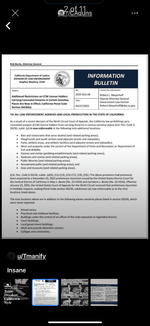
Actually, the fact that it is a shared parking lot makes it a "go". Only parking lots dedicated to 'sensitive places' are considered 'sensitive places' themselves. You are good-to-go when out for groceries (just don't enter the Brewery next door).
I just don't want to be the test case. The DOJ memo says "and related parking". Not willing to test that.
 
It was clarified in one of the trips to the 9th circuit. Doesn't mean a cop on the street will be 100% up to speed but you shouldn't have to worry about a DA charging. At least not until the next ruling from the 9th.
 
There are no federal injunctions in-place to the best of my knowledge. The 9th circuit, in March 2025, ruled this law to be constitutional and SCOTUS has not yet agreed to hear the appeal. There was a temporary injunction in place from September 2023 at the district court level but, that injunction was reversed by the en banc 9th circuit court.

Did I miss something?
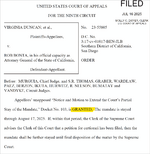
Partial stay of the mandate is still in placestay.png
 
On the issue of other lawyers, every lawyer has their take on this and the laws overall. But no lawyer is going to give you actual legal advice that is contrary to the letter of the law, because it is an ethical violation to do so (Rule 1.2.1). So don't even bother asking for a lawyer to tell you that you can do these things. However, a lawyer can tell someone what the likely consequences of a given course of conduct are, and also help the client determine the scope and constitutionality of the law. You all are not clients, so I'm just going to break it down for you as best I can: the CCW statute clearly says you cannot drink while carrying, so don't do it. The sensitive places law says you can't carry in any restaurant that serves alcohol. I'm not saying you should do it, but practically speaking, unless you have an incident in a restaurant that serves alcohol, it's highly unlikely anyone would ever notice or have a problem with this. So the 51% test evolved for agencies to determine whether the permit holder was at least making a good faith effort to comply-- for example, carrying in a wine bar whose primary purpose is tasting wine would fail the test, while carrying at an Applebee's would pass that test if the permit holder is not drinking. I personally would rather make that choice and have the gun with me, and not drink, but it's up to everyone how much risk they can tolerate. If you are drinking at a restaurant and get into an incident, at a minimum your agency will revoke your CCW. If you're not drinking...no one knows, but I doubt anything will happen due to the common 51% test that agencies are allowing in their CCW training providers' materials. Confirm your trainers' position on this before deciding. Note that violating any law (i.e., the ban on drinking while carrying) also means you are often presumed liable for negligence, which is called "negligence per se." As far as I know, this theory of negligence hasn't been used in a CCW civil liability case yet because it would only be relevant for third party injuries, but do you really want to be the test case? What if someone says they saw you drinking when you really weren't? Not everyone acts rationally. In conclusion, you could assess that it is worth the unknown probability of losing your CCW if you are able to effectively use it in one incident that saves your or someone else's life. If I were you, I would think hard about it and make a logical decision that gives you a balance between risk and protection. I've explained what I would do-- doing what my trainer said, consistent with the 51% test-- so if you copy me, that is one way to do it. But if I'm called as a witness in your case, don't expect me to say anything other than that I wrote this post and told you to make your own decision with this in mind.
 
Partial stay of the mandate is still in placeView attachment 90395
I stand corrected! Good to know about the partial stay. Thanks for posting this, I could not find any stays or injunctions. Apparently, the partial stay makes it legal to possess the larger magazines, not sure about using them. If SCOTUS declines the case, this stay expires.
 
I stand corrected! Good to know about the partial stay. Thanks for posting this, I could not find any stays or injunctions. Apparently, the partial stay makes it legal to possess the larger magazines, not sure about using them. If SCOTUS declines the case, this stay expires.
If you read California Penal Code § 32310, you'll see sections (a) and (b) are all about "who manufactures or causes to be manufactured, imports into the state, keeps for sale, or offers or exposes for sale, or who gives, lends, buys, or receives any large-capacity magazine" and sections (c) and (d) are about possession.

Usage does not appear once in 32310 (nor in any other penal code), therefore if you're allowed to posses it, you're allowed to use it.

And yes, if SCOTUS declines to hear the case, or it rules in favor of the state, the stay will expire.
 
Regarding National (Federal parks, and USFS lands [but NOT USFS administrative buildings]), per a NPS ranger (badged peace officer) CCW is acceptable. STATE parks, per my conversation with a trusted state parks superintendent, NO CCW.

Restaurants that serve alcohol: if their primary business is food preparation and consumption, and NOT primarily for alcoholic beverage consumption, CCW is acceptable. Bars, taverns, nightclubs, things where alcohol is the primary product, CCW NOT acceptable.

Disclaimer: I offer the above only based on my conversations with some of those empowered with enforcement of CCW issues. I suggest that anything you read on the internet be further researched before concluding that it is correct.

What I find (other than that I believe the whole permitting process is BS) most bothersome is that a local beach area campground I frequent by one of my favorite surfing spots is a no-go, although I admit that after having been there many, many times for overnight stays, I’ve never had so much as the slightest occasion wherin a firearm was even considered.
Its all resturants now. Before it was “bars” and bar area if the main eating area is closed. Is not my country but the PC code is sate wide.
 

Attachments

  • IMG_1625.png
    IMG_1625.png
    70.3 KB · Views: 5
Re: restaurants and alcohol. I’ve posted this before, but it still seems to confuse folks. The confusion exists due to a conflict in the SB 2 language and the Application, itself:

The confusion comes from two separate sections of the Code from SB2 conflicting with each other:
26200 (a) While carrying a firearm as authorized by a license issued pursuant to this chapter, a licensee shall not do any of the following:[…]
(2) Be in a place having a primary purpose of dispensing alcoholic beverages for onsite consumption.
This was carried over from the CCW Application in Section 5, Conditions and Restrictions (Page 10). Since this was on the previous app, the bill author sought to codify all of the conditions itemized on the application to give them the force of law.

But, when SB 2 was enacted it also contained a separate list of prohibited “sensitive spaces” which included:
26230 (a) A person granted a license to carry a pistol, revolver, or other firearm capable of being concealed upon the person pursuant to Section 26150, 26155, or 26170 shall not carry a firearm on or into any of the following:[…]

(9) A building, real property, and parking area under the control of a vendor or an establishment where intoxicating liquor is sold for consumption on the premises.

Since 26230, although enacted at the same time, follows 26200, the legislature is inferred to have known about 26200 but still required this overriding statute. That makes 26230 the controlling text. This language wasn’t enjoined by the court.

Since the “primary purpose” clause is on the app, it is very easy to stop reading the code and accept that result. Equally, one could read SB2 and stop at 26200 with an “AHA”. However, the “sensitive spaces” section of 26230 enhances the prohibition to encompass anywhere alcohol is sold for consumption on the premises. That covers Applebys and anywhere else that serves food and offers alcohol of any kind for consumption on the premises.
 
Last edited:
You all are not clients, so I'm just going to break it down for you as best I can: the CCW statute clearly says you cannot drink while carrying, so don't do it. The sensitive places law says you can't carry in any restaurant that serves alcohol. I'm not saying you should do it, but practically speaking, unless you have an incident in a restaurant that serves alcohol, it's highly unlikely anyone would ever notice or have a problem with this. So the 51% test evolved for agencies to determine whether the permit holder was at least making a good faith effort to comply-- for example, carrying in a wine bar whose primary purpose is tasting wine would fail the test, while carrying at an Applebee's would pass that test if the permit holder is not drinking. I personally would rather make that choice and have the gun with me, and not drink, but it's up to everyone how much risk they can tolerate. If you are drinking at a restaurant and get into an incident, at a minimum your agency will revoke your CCW. If you're not drinking...no one knows, but I doubt anything will happen due to the common 51% test that agencies are allowing in their CCW training providers' materials.
Thanks; all good points. I would emphasize that if one is found to be in violation of the statutory provisions, the IA and the DA seem well within their rights to declare the license null and void at the point of violation. This makes everything that happens afterward subject to unlicensed concealed and unlicensed loaded carry prohibitions.

We saw this play out in Sacramento in 2014, well before SB 2. A Mendocino Assistant DA, Damon Gardner was in town with his girlfriend (a probationary ADA) and went out drinking while armed under a CCW. He did stupid stuff and got jumped by two guys. As they were kicking him in the head, he drew and shot one of the perpetrators. The shooting was ruled self defense, but Gardner was charged with unlicensed concealed carry and unlicensed carry of a loaded firearm. A plea deal got one count dropped, 3 years probation and 30 days on the Sheriff’s works project. He and his girl friend also got fired.
Sacramento prosecutors filed two counts on Gardner related to his possession of the gun, for which he had a carry permit. The permit, however, was invalid if he was under the influence of alcohol or drugs, which led to the criminal filing. Prosecutors dismissed the other count on Gardner of carrying a concealed weapon in public. Chief Deputy District Attorney Steve Grippi said Friday the shooting appeared to be in self-defense. “We felt there was sufficient evidence we couldn’t overcome self-defense,” Grippi said in an interview.
Clearly, the Sac Chief DDA was looking to prosecute this guy on the shooting, but couldn’t get past the self-defense truth. So, he took the invalidated license route (I’m sure there were discussions with Mendocino DA). I hate to say it but today, thanks to SB 2, there are far more prohibitions which can be applied to invalidate the CCW license. Simply walking into a parking lot controlled by Appleby’s appears to invalidate the license at that point. If you have any kind of law enforcement encounter, it may be possible for them to roll you up under SB 2 provisions. If you shoot someone, you may get a “good shooting” self-defense review by the LEOs and the DA, but like Mr. Gardner, you may be looking at charges of carrying a gun without a license.

Your life; Your dice. Roll ‘em.
 
I would emphasize that if one is found to be in violation of the statutory provisions, the IA and the DA seem well within their rights to declare the license null and void at the point of violation.
I have said the same thing: If you violate either black letter law (you shall not carry in these places ...) or the restrictions on your CCW license (you shall not carry in these places ...), then one could infer that the license is invalid at that moment, therefore one is committing the crime of unlicensed concealed carry. The Gardner case confirms that ... except that in that case, the defendant (an attorney themselves, duh) accepted a plea deal, so it does not create precedent.

BUT: The esteemed RickD427 disagrees with me on this, and says that an agency can't invalidate a permit just by saying "it will become invalid automatically if you do this thing". They would need to do this officially, with due process, and paperwork (i's
crossed and t's dotted or something like that). Since he knows much more about the law than I do, I now defer to his view, and no longer know.

Still: I would NEVER EVER use a CCW at Appleby. I'm risk averse.
 
I have said the same thing: If you violate either black letter law (you shall not carry in these places ...) or the restrictions on your CCW license (you shall not carry in these places ...), then one could infer that the license is invalid at that moment, therefore one is committing the crime of unlicensed concealed carry. The Gardner case confirms that ... except that in that case, the defendant (an attorney themselves, duh) accepted a plea deal, so it does not create precedent.

BUT: The esteemed RickD427 disagrees with me on this, and says that an agency can't invalidate a permit just by saying "it will become invalid automatically if you do this thing". They would need to do this officially, with due process, and paperwork (i's crossed and t's dotted or something like that). Since he knows much more about the law than I do, I now defer to his view, and no longer know.

Still: I would NEVER EVER use a CCW at Appleby. I'm risk averse.
{Emphasis above, added.}

We share some background: I too have had a few contretemps with RickD427 (and Librarian) over the years, including this one. But, that was before the Gardner issue appeared which seemed to validate the concept that even in the absence of statutory authority, the application itself constrained the license “at birth.” All that fell to the wayside when SB 2 was passed. Now the statutes delineate numerous provisions which tell the CCW holder what they (even though licensed) cannot do under the authority of that license. The agency no longer has a say in the issue…it’s not a policy interpretation. The statute says, “Thou shalt not”. If you do this, you have committed an act prohibited under the license. That would seem to void the license and doesn’t require administrative nuance.

26200.​

(a) While carrying a firearm as authorized by a license issued pursuant to this chapter, a licensee shall not do any of the following:

26230.​

(a) A person granted a license to carry a pistol, revolver, or other firearm capable of being concealed upon the person pursuant to Section 26150, 26155, or 26170 shall not carry a firearm on or into any of the following:
I’m not a lawyer, but I am sure I understand that.
 
Now the statutes delineate numerous provisions which tell the CCW holder what they (even though licensed) cannot do under the authority of that license. The agency no longer has a say in the issue…it’s not a policy interpretation.
Thank you for pointing that out, and it makes a significant difference. I bought RickD427's argument that the IA can't just invalidate a license because ... but black letter law that says "you shall not" is much more obvious. It's quite possible that my discussion with Rick was BEFORE SB2 passed, so it may no longer even be applicable.
 
Back
Top Bottom