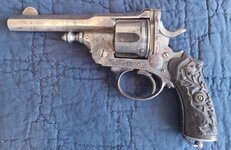
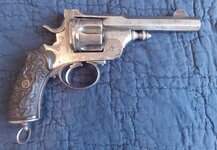
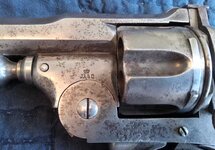
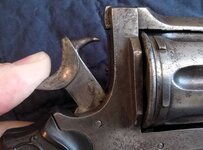
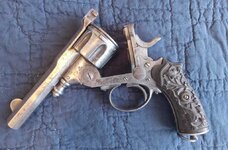
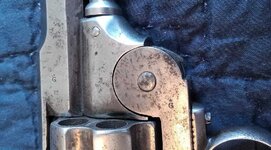
I have an old revolver that I'd like to identify. The cylinder bores are .388" in diameter, so maybe chambered for .38 S&W? It has few identifying marks, other than the "JA&C" proof mark on the left side of the frame, and a couple of "G" (with a star) proof marks on the right side. There's also a "V" mark on the cylinder. The firing pin resembles a claw. The grips have an elaborate dragon and vine motif. The barrel is bulged from some long past mishap, and the trigger must be manually returned to position so there's some internal malfunction. Any information as to manufacturer and age would be greatly appreciated!

caguns.net
Welcome to CAguns.net!
Join our growing community where you can ask questions, share knowledge, or browse our classifieds section.
Sign up for a free account today and unlock full access! Once registered, you can search, post, and take advantage of exclusive features unavailable to guests.
A note on why more of the site now requires an account: automated scrapers and AI systems have been crawling our forums and classifieds at a scale. Requiring sign-in for those sections is the most effective tool we have. It takes a minute to register, it's free, and it keeps what happens here between actual members.
New to California gun ownership or trying to keep up with the changing laws? Check out our sister site CA2A.com — free courses, plain-English legal updates, and step-by-step guides built for California owners.
Advanced features are available only to registered members. Register today!

You are using an out of date browser. It may not display this or other websites correctly.
You should upgrade or use an alternative browser.
You should upgrade or use an alternative browser.
Whut Izzit?
- Thread starter IMR-4320
- Start date



- Messages
- 150
Belgian?
- Messages
- 150
It looks like a top break MK1 Webley variant?



- Messages
- 324
- Classified ads
- 4
Found this it may help
also look at wikipedia
The initials "J.A.&C." or similar variations might refer to a company called
JA Industries, which is an American firearms manufacturer based in Henderson, Nevada.
JA Industries has a complex history, evolving from Jennings Firearms, founded in 1978, to Bryco Arms after bankruptcy, and then becoming Jimenez Arms in 2004 under Paul Jimenez. After Jimenez Arms also filed for bankruptcy in 2020, its assets were transferred to JA Industries, also owned by Jimenez. In April 2022, the Bureau of Alcohol, Tobacco, Firearms and Explosives (ATF) revoked JA Industries' federal firearms license. The company's remaining firearms were reportedly purchased and destroyed by Everytown.
Separately, an online listing for a "Target Sealed 8 Shot Revolver" references "I. JA@C.WKS." and dates from 1932-1941. These dates are prior to the founding of JA Industries, suggesting "I. JA@C.WKS." might refer to a different, older company with similar initials.
also look at wikipedia
The initials "J.A.&C." or similar variations might refer to a company called
JA Industries, which is an American firearms manufacturer based in Henderson, Nevada.
JA Industries has a complex history, evolving from Jennings Firearms, founded in 1978, to Bryco Arms after bankruptcy, and then becoming Jimenez Arms in 2004 under Paul Jimenez. After Jimenez Arms also filed for bankruptcy in 2020, its assets were transferred to JA Industries, also owned by Jimenez. In April 2022, the Bureau of Alcohol, Tobacco, Firearms and Explosives (ATF) revoked JA Industries' federal firearms license. The company's remaining firearms were reportedly purchased and destroyed by Everytown.
Separately, an online listing for a "Target Sealed 8 Shot Revolver" references "I. JA@C.WKS." and dates from 1932-1941. These dates are prior to the founding of JA Industries, suggesting "I. JA@C.WKS." might refer to a different, older company with similar initials.

- Messages
- 52
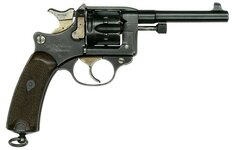
According to chatgpt
Yes, the revolver in the image is a Lebel Model 1892 (often referred to as the Modele d’Ordonnance 1892), a French military revolver.
Key identifiers:
• Distinctive loading gate and solid frame.
• The right-side swing-out cylinder is unusual for its time (it was one of the first revolvers to feature this).
• The engraved black grip panels and ornate grip design are often seen on officer-issued or ceremonial models.
• The cylinder pin and ejector rod placement and style are also unique to the Lebel 1892.
Quick facts:
• Caliber: 8mm Lebel revolver (8x27mmR).
• Service use: French Army, officially from 1892 through both World Wars.
• Nickname: Sometimes called the “Lebel Revolver” although it wasn’t designed by Colonel Lebel—it just entered service under his name era.
It’s considered a high-quality military revolver for its time, known for its precision craftsmanship.
Not exactly a swing out cylinder though.
Yes, the revolver in the image is a Lebel Model 1892 (often referred to as the Modele d’Ordonnance 1892), a French military revolver.
Key identifiers:
• Distinctive loading gate and solid frame.
• The right-side swing-out cylinder is unusual for its time (it was one of the first revolvers to feature this).
• The engraved black grip panels and ornate grip design are often seen on officer-issued or ceremonial models.
• The cylinder pin and ejector rod placement and style are also unique to the Lebel 1892.
Quick facts:
• Caliber: 8mm Lebel revolver (8x27mmR).
• Service use: French Army, officially from 1892 through both World Wars.
• Nickname: Sometimes called the “Lebel Revolver” although it wasn’t designed by Colonel Lebel—it just entered service under his name era.
It’s considered a high-quality military revolver for its time, known for its precision craftsmanship.
Not exactly a swing out cylinder though.
- Messages
- 141
I'm willing to bet it's not part of the Jennings legacy. Or Bryco, and so on. Those were part of the ring of fire, inexpensive semi-auto pistols. They wouldn't have chambered anything in .38 S&W, short Colt, or whatever IMO. I'm pretty sure I never saw a revolver from them. Back in those days I was in at least one gun store every week. That design is long before 1978.
Funny thing, I dated a girl that had purchased a Jennings in .22, and that thing worked every time, only cost $30. All over the paper at 25 yards, not sure every shot hit the paper. It worked though.
The above is likely European, although a small chance it was made in NA.
I don't know where my reference books are these days, sorry. That one might be obscure enough it might miss many reference books. It'll be interesting to learn - maybe contact the NRA? There's a local guy that might know, I'll try to remember to hit him up.
Funny thing, I dated a girl that had purchased a Jennings in .22, and that thing worked every time, only cost $30. All over the paper at 25 yards, not sure every shot hit the paper. It worked though.
The above is likely European, although a small chance it was made in NA.
I don't know where my reference books are these days, sorry. That one might be obscure enough it might miss many reference books. It'll be interesting to learn - maybe contact the NRA? There's a local guy that might know, I'll try to remember to hit him up.
- Messages
- 150
Are there any markings under the grip?

- Messages
- 68
Very similar to this: https://www.1898andb-4.com/guns/warnant-brevetes-d-a-44-webley-bull-dog-caliber/
or this https://www.ima-usa.com/products/or...50-revolver-circa-1870?variant=41936749592645
Different makers mark with * G which may relate to Charlier Josef
or this https://www.ima-usa.com/products/or...50-revolver-circa-1870?variant=41936749592645
Different makers mark with * G which may relate to Charlier Josef
I'd say you'd nailed it! .38 caliber variant, but other than that and the grips, pretty much identical to the Belgian revolver in the second link.Very similar to this: https://www.1898andb-4.com/guns/warnant-brevetes-d-a-44-webley-bull-dog-caliber/
or this https://www.ima-usa.com/products/or...50-revolver-circa-1870?variant=41936749592645
Different makers mark with * G which may relate to Charlier Josef
Thanks!
- Messages
- 141
Could be maybe a cheapo copy of one of the above links? The detail on the trigger guard is different than either of the links, which makes me think it was a different manufacturer. Detail on the thumb release is a little different, but maybe this is a less expensive/later version? Surely a lot of design similarities. The history of firearms is interesting!
- Messages
- 18
It’s hard to be sure, but it looks Belgian. Belgian firearms are an extremely interesting subject, which I unfortunately know only a little about. There were hundreds, if not thousands, of small cottage producers, making firearms based on all sorts of designs, often by hand. This practice continued for centuries; even FN was more like a clearinghouse or arsenal and repair facility for independently made firearms in its early days.
Given that yours is a break action and does not appear to be double action (based on trigger and hammer position), it’s not a direct Bulldog copy. But it has some features reminiscent of one. It could be another design entirely, one unique to that manufacturer, or one that was circulating in the Belgian firearms industry.
The crown over JA&C looks like manufacturers initials. It might be J. Ancion & Cie., which was based in Liege. However the star over G is not the normal Liege/Belgian proof mark, which changed over time, but was usually some form of E/LG. Star over G is an inspector’s mark listed as belonging to Charlier Josef, who served from 1928-1959. This seems too late for this revolver, so perhaps it is an earlier use of that particular mark by another inspector.
Honestly, I have no idea how to interpret all this. Not everything was super consistent in Belgium at the time.
Given that yours is a break action and does not appear to be double action (based on trigger and hammer position), it’s not a direct Bulldog copy. But it has some features reminiscent of one. It could be another design entirely, one unique to that manufacturer, or one that was circulating in the Belgian firearms industry.
The crown over JA&C looks like manufacturers initials. It might be J. Ancion & Cie., which was based in Liege. However the star over G is not the normal Liege/Belgian proof mark, which changed over time, but was usually some form of E/LG. Star over G is an inspector’s mark listed as belonging to Charlier Josef, who served from 1928-1959. This seems too late for this revolver, so perhaps it is an earlier use of that particular mark by another inspector.
Honestly, I have no idea how to interpret all this. Not everything was super consistent in Belgium at the time.
- Messages
- 18
After looking at those links shared earlier, I think this is definitely a Webley-Pryse type design as shown in the others. Yours could have a broken double action mechanism - normally the hammer would be slightly rebounded and the trigger much further forward. Maybe the trigger return spring (which would be a u shaped flat spring) snapped in half.
Again, firearms were a cottage industry, with manufacturers parroting each others’ designs and outright copying foreign patents. Parts interchangeability is going to be nigh on impossible between manufacturers. If you want to fix it, you’ll need to start making parts.
Again, firearms were a cottage industry, with manufacturers parroting each others’ designs and outright copying foreign patents. Parts interchangeability is going to be nigh on impossible between manufacturers. If you want to fix it, you’ll need to start making parts.