18+ Content Warning

By clicking Enter, you confirm you are 18 years of age or older and agree to comply with all applicable local, state, and federal laws.

Notice: Any content or member activity - including anything you may buy, sell, transfer, or discuss - must comply with current and upcoming laws.

Members are encouraged to stay informed: California Firearm Laws: 2026 Outlook & 2025 Recap . Responsibility for compliance rests solely with the individual member.

caguns.net

Welcome to CAguns.net!
Join our growing community where you can ask questions, share knowledge, or browse our classifieds section.

Sign up for a free account today and unlock full access! Once registered, you can search, post, and take advantage of exclusive features unavailable to guests.

A note on why more of the site now requires an account: automated scrapers and AI systems have been crawling our forums and classifieds at a scale. Requiring sign-in for those sections is the most effective tool we have. It takes a minute to register, it's free, and it keeps what happens here between actual members.

New to California gun ownership or trying to keep up with the changing laws? Check out our sister site CA2A.com — free courses, plain-English legal updates, and step-by-step guides built for California owners.

Advanced features are available only to registered members. Register today!

Tap and die setup

couragewolf

Well-known member
Messages
949
I’m realizing I need to get my tap and die game going but don’t want to spend a fortune doing it.

Other than the obvious 5/8-24 what taps and dies would you all consider critical must haves in your kit for common gunsmithing sort of machining? I don’t really have any immediate goals in mind but I do want to have the right ones on deck if I ever really needed to fix something that’s more than just a thread chaser situation.
 
it depends on the type of weapon that you are working on 6-40,6-48,8-40,8-48. metric.
Pick up a thread gauge and read the different sizes.
 
I’m realizing I need to get my tap and die game going but don’t want to spend a fortune doing it.

Other than the obvious 5/8-24 what taps and dies would you all consider critical must haves in your kit for common gunsmithing sort of machining? I don’t really have any immediate goals in mind but I do want to have the right ones on deck if I ever really needed to fix something that’s more than just a thread chaser situation.
Do not use dies to thread barrels if you want the threads to be concentric and straight to the bore.
So many people cut threads crooked on barrels and then bring them to me to be fixed.
The fix normally involves shortening the barrel and then usually having to perm attach something since the barrel is under 16” after shortening to remove the crooked threads.

Proper barrel threads are single-point cut on a lathe.
 
Do not use dies to thread barrels if you want the threads to be concentric and straight to the bore.
So many people cut threads crooked on barrels and then bring them to me to be fixed.
The fix normally involves shortening the barrel and then usually having to perm attach something since the barrel is under 16” after shortening to remove the crooked threads.

Proper barrel threads are single-point cut on a lathe.
I guess for an od thread cut like on a barrel there’s no guide or jig one can use to maintain barrel concentricity like one can with a drill and tap so that checks out. Don’t think a lathe is in the cards for me sadly.
 
I guess for an od thread cut like on a barrel there’s no guide or jig one can use to maintain barrel concentricity like one can with a drill and tap so that checks out. Don’t think a lathe is in the cards for me sadly.
I’m going to second what AR15 barrels said. Guides work fine for taps, but not so much for dies. If it were a guide that were able to align both the die and barrel with zero vertical or horizontal deflection, and the OD were the proper size, that might work fine. But it does not take much deflection for the die to start crooked, or cut off center leaving the threads deeper on one side and more shallow on the other. Single point is the way to go for OD threads.
 
I’m going to second what AR15 barrels said. Guides work fine for taps, but not so much for dies. If it were a guide that were able to align both the die and barrel with zero vertical or horizontal deflection, and the OD were the proper size, that might work fine. But it does not take much deflection for the die to start crooked, or cut off center leaving the threads deeper on one side and more shallow on the other. Single point is the way to go for OD threads.
I m dumb enough to ask but smart enough to learn
 
I guess for an od thread cut like on a barrel there’s no guide or jig one can use to maintain barrel concentricity like one can with a drill and tap so that checks out. Don’t think a lathe is in the cards for me sadly.
There are actually, but it takes patience and time to do it right. I have done it a few times and it came out perfect each time. Lent my friend my tools/jigs etc and his came out crooked because he rushed.

But, yes, a lathe is the preferred way to thread a barrel if you can.
 
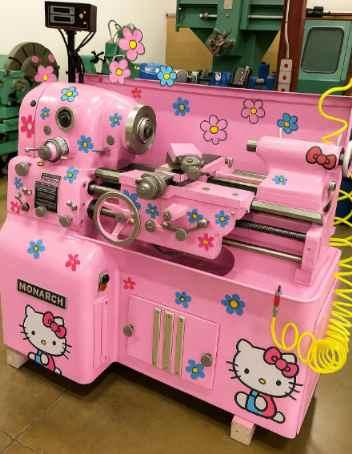
You don't need a full size 2000 pound lathe for gunsmithing tasks. You can do most things with a little Harbor Freight benchtop lathe... usually $250 or so on FB marketplace etc. The important spec is spindle/chuck through hole size.... your barrel is going to need to stick out the rear end of the spindle. I'm not saying you don't need to know how to use one, but start practicing on delrin, aluminum etc. & gain some skills. Learn little tricks like turning the cutter upside down & turning away from the chuck rather than into it. YouTube is your friend.
 
I’m realizing I need to get my tap and die game going but don’t want to spend a fortune doing it.

I'm not a gunsmith--then again, neither are 95% of the jokers who try to peddle their slipshod skills as those of real gunsmiths. With that said, don't be a cheapskate. A broken tap will make you very sad and could complicate your day immensely. Junk taps are more prone to breakage at inopportune times. If you stick with American, European, or even some Taiwanese brands, you improve your odds. That's not to say that tools from some other countries aren't satisfactory, I'm just not smart enough to figure it out.

When people ask me what specific size tool they need to complete a certain task, I once again tell them not to be a cheapskate. If you have one tool, you can do one thing. Next week when you're faced with a different task, you'll once again be dead in the water without the needed tool. Buy the whole set of wrenches. Buy the set of drills. Buy the set of taps and dies. Then you'll be better prepared to tackle whatever task comes before you.

Of course most folks just can't go out and buy everything they could possibly need, unless their name is Bezos or Gates. You'll have to figure out your priorities. Just don't be the one tool at a time guy.

Don't even think about buying a lathe. You're far from that at this time. Get the taps and dies if you want. Good files are pretty important. And of course standard screwdrivers and wrenches. Got a good vice on a good bench? There are so many things you need first.
 
I'm not a gunsmith--then again, neither are 95% of the jokers who try to peddle their slipshod skills as those of real gunsmiths. With that said, don't be a cheapskate. A broken tap will make you very sad and could complicate your day immensely. Junk taps are more prone to breakage at inopportune times. If you stick with American, European, or even some Taiwanese brands, you improve your odds. That's not to say that tools from some other countries aren't satisfactory, I'm just not smart enough to figure it out.

When people ask me what specific size tool they need to complete a certain task, I once again tell them not to be a cheapskate. If you have one tool, you can do one thing. Next week when you're faced with a different task, you'll once again be dead in the water without the needed tool. Buy the whole set of wrenches. Buy the set of drills. Buy the set of taps and dies. Then you'll be better prepared to tackle whatever task comes before you.

Of course most folks just can't go out and buy everything they could possibly need, unless their name is Bezos or Gates. You'll have to figure out your priorities. Just don't be the one tool at a time guy.

Don't even think about buying a lathe. You're far from that at this time. Get the taps and dies if you want. Good files are pretty important. And of course standard screwdrivers and wrenches. Got a good vice on a good bench? There are so many things you need first.

I was a quality manager at a fairly large machine shop(dozens of lathes, mills, horizontal mills, a half dozen CNCs and a horizontal mill with a chuck large enough to put a volkswagen in it. I'm not entirely unfamiliar with what machining looks like in practice I just haven't done a ton of it myself.

I don't pretend to be a gunsmith or anything I just like learning new stuff and there's something particularly magical about being able to make metal do whatever you want. I screw around with welding and woodworking and AI and all kinds of stuff and who knows maybe one day they'll be handy skills but for now I'm just exploring what's possible.

Should note; I know how dangerous these tools are as well I've seen some accidents that outside of war I think the vast majority of people have not experienced. I wear short sleeves in the garage :sneaky:
 
Back
Top Bottom