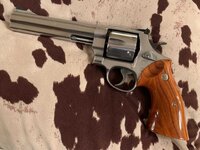
Failures of the S&W lock are indeed very rare.
How many times does it save someone's life? We don't know that, since most examples of the lock working correctly (preventing someone, typically a small child, from firing the gun) don't get recorded at all, since nothing happened. I'll talk about the safety versus usefulness tradeoff more in a moment.
it is one more mechanism that serves no purpose other than to appease the legal industry.
It's actually not the "legal industry", it was politics.
During the Clinton era, in the 90s, S&W (and a few other gun makers) came into the cross hairs of the federal government. Just like big tobacco had been caught doing lots of shady things (like knowingly lying about the fact that smoking is unhealthy), the big gun makers had been found to be at least very sloppy (closing their eyes to supplying the black market was the big one), and there was plenty of evidence that they were doing this with full knowledge. Just like big tobacco had been forced into a giant settlement, under threat of being sued out of existence, the Clinton administration wanted to do the same thing to the biggest gun companies. But the nature of the settlement had to be different: While the tobacco companies were making money hand over fist and sitting on billions, the gun makers were actually barely making ends meet. In particular S&W, the archetype of American gun companies (together with Colt, which was in even worse shape) was so poor, they had already been sold to various investors several times over.
The settlement that was reached was that S&W would improve its business practices, police its dealers to not sell to children nor to prohibited parties, have the dealers implement theft prevention, and that all S&W handguns would have a a safety, and later also loaded chamber indicators and magazine disconnects. In exchange, federal and state government dropped all the lawsuits against S&W (and the other gun makers), and made them a "preferred supplier", in particular to law enforcement. The safety for pistols was implemented as the little hole with a key. The "preferred supplier" agreement was explicitly intended to compensate the gun makers for the expectation that consumers would be boycotting them (as they ended up doing). Without the settlement, S&W would have certainly been wiped out. Since then, government sales have been the lifeline that has kept S&W barely afloat. I think their net profit these days ends up being a million or so per quarter; not a way to run a company.
Magazine disconnect: Any pistol (or other firearm) so equipped becomes NOTHING MORE than an inefficient impact weapon when it cannot fire ammunition. If you elect to carry only one magazine in your carry weapon, or out in the hunting field and for some reason drop or loose it, it is a club.
Interesting viewpoint. If that is really so, how can you explain that the service handgun of the Swiss military has had a magazine disconnect since 1950? As do most military handguns? Wouldn't one think that of all people, soldiers would need something better than a club?
If you fail to fully seat the magazine while attempting a quick reload the result will be that the weapon will not fire as well.
A correct engineered magazine disconnect will not do that. Look at the Sig P210: As long as the magazine is about 3/4 of the way in (not even fully seated, nor latched), it will fire.
If you ever attend really good training or practice, the skill of being able to drop a single round into the chamber from slide-lock and getting the weapon back into action quickly when you have no magazine becomes a moot point.
I hope you won't claim that the Swiss army is badly trained.
The above reasons are why I will NEVER rely on any weapon with a magazine disconnect. If it cannot be disabled or removed altogether, it is nothing more than a range toy.
Strange. Millions of soldiers disagree with you. They go to war with what you would consider a "range toy".
Seriously: Like most things in engineering, the magazine disconnect (as well as the safety on a gun) is a tradeoff. Yes, it adds complexity to the system, and typically extra weight, extra parts. And extra failure modes, although those are very very rare. If implemented correctly (and not all gun makers are actually good at engineering), they should not impact the feel of the trigger, as they should not be even touching the trigger itself, the linkage, or the sear when in the "fire" position. The tradeoff of that little bit of extra complexity is that the gun is safer to operate, namely less likely to get fired when the user doesn't with it to fire. Users that want to carry these guns need to be trained in the manual of arms, namely that firing requires (a) releasing the safety, and (b) having a magazine (even an empty one) fully inserted. For guns that are commonly carried, the general consensus seems to be that this is a good tradeoff. For your personal gun purchases, you are free to disagree. But please understand that people with your attitude would be thrown out of the military in most countries.