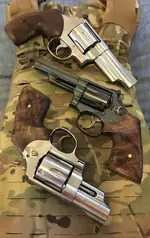
For those of you who carry a revolver and have qualified with it, did you pull the trigger double action or did you manually

the hammer for each shot? I'm in the process of applying and added my Taurus 85 to my list of firearms. My IA does not have a timed limit, simply 10rnds at 5 and 10rnds at 7yds for additional firearms. My problem is the DA trigger pull on the Taurus is heavy AF! I'm confident I can do it evident from recent practice but just curious what other people have done when qualifying with a revolver. SA or DA? TIA
Ed McGivern demonstrated that double action pull is faster in his book "Fast and Fancy Revolver Shooting" (published in 1935 and it was a big deal at the time). You will need more trigger time to master it, but that's what dry fire is for (always use AZOOM Snap Caps!). However, you MUST confirm with live fire because the recoil impulse of a revolver is different.
Be very careful of the "gun rule of thumb" to use double action only. Almost everyone is going to parrot that line without knowing why. For police, their goal is to make an arrest without injuring anyone. They will sometimes hold a suspect at gun point. Unfortunately, as Ed McGivern complained in his book in 1935, police training is often lacking and reinforcing those skills is also neglected. A longer, heavier trigger is intended to help prevent a discharge due to the hand clenching response under stress. The gun can still fire, but the heavy trigger at least is easier to feel when blood is reduced in the hand and the officer will hopefully notice and stop before anything happens.
But as a civilian defender, is it likely you're going to hold a suspect at gunpoint? Probably not. So, then we will take advantage of the SPEED of the double action trigger to shoot faster while maintaining accuracy. You can certainly
that hammer for a precision shot. Just understand the circumstances of such a shot; you may have an attacker shooting at you from a distance behind cover. In that case, it makes sense to utilize the lighter trigger pull of the single action.
You cannot buy your way to proficient revolver shooting, and you must get some training to be effective with a snubby. Fortunately, you can do it yourself by reading some books and building a training plan.
If you have a snubby, then you really must do two things: 1) get an action job and 2) BURY THAT FRONT SIGHT IN THE REAR GROOVE!!!!! Here are some books to read:
"The Snubby Revolver" by Ed Lovette
"The Gun Digest Book of the Revolver" by Grant Cunningham
"No Second Place Winner" by William Jordan. (Must read for any revolver shooter)
"Protect Yourself with Your Snubnose Revolver" by Grant Cunningham
I **highly** recommend not bothering to have a gunsmith work on a Taurus. Instead, call up one of the revolver gunsmiths, buy a S&W, Ruger, or Colt (recommendations below) from them, and have them perform the following:
1) Action job
2) Add night sights
3) Chamfer charge holes
4) Radius trigger face
Yes, you will pay a premium. Yes, the work will be expensive. Yes, it's gonna hurt your wallet. The difference in performance between my 629 4", which was tuned by Denny Riechards at Sand Burr Gun Ranch, and my stock 629 3" Deluxe is night and day. My 629 Deluxe is atrocious out of the box. It needs professional attention.
Now, I know you have a snubnose revolver, but those are guns for EXPERTS. I highly recommend you acquire a revolver with 4" barrel. You could get one with a 5" or 6" barrel, but they're tough to carry for defense. Not 3.5" and not 4.25" (though you may not have a choice there). The reason is that 4.25" doesn't fit in most holsters and many quality manufacturers seem to not have adapted to the new length (it's a reaction to Canada's law on barrel length). Every one of the old timers writes in their books that 4" is the minimum length for decent performance and ease of shooting.
Guns for Learning Revolver Shooting:
- Ruger GP100 4". You could try a 3", but the old timers stated 4" for a reason. 5" and 6" are excellent, but you cannot carry them and are therefore training guns.
- S&W 686 Plus (seven shot) or 686
- Colt Python 4"
- S&W Model 10 4" (38 Special)
- S&W Model 19 or 66. These are the quintessential carry revolvers. The new versions from S&W handle 357 Magnum well.
- S&W Model 627 (large N-frame, 8 shot cylinder). It's an awesome gun but many believe it is too large to carry. It's a great training gun for 357 Magnum.
- S&W Model 327 M&P R8 or TRR8 (5" barrel, 8 shot cylinder). These have magic in the barrel and are awesome shooters.
I was all gungho for the Colt King Cobra and Colt Cobra, but they've been having trouble with broken hammers. Something about the new design may not be right.
Do not discount the these guns solely because of this statement; research it carefully before you buy because Colt may have solved the problem. They will know the serial number range for guns with hammer problems. However, the King Cobra 4" has a great frame size for shooting and concealed carry.
In case the hammer problems have not resolved, then the S&W K-Frame is a great alternative. These are the Model 10, Model 19 (blued), Model 66 (stainless) and others.
The frame sizes for the Models 10, 19/66 are smaller than the 686 and 586 series and are the K Frame for the former and L Frame for latter. The L frame is "beefier" than the K, but the grip is the same for both (so if the K fits your hand, then the L will too). In case you're wondering, the "5xx" series are blued and the 6xx series are stainless steel.
The Ruger GP100 is also an excellent handgun. I like mine quite a bit. It's equivalent to the S&W 586/686 L-Frame. It features a modular grip module. I use the Ruger small grip to enhance concealment and it fits my hand perfectly. A variety of manufacturers make stocks for it.
If you don't know what to get, go larger. A larger, heavier gun with a longer barrel will help with recoil. It will increase your tolerance for hotter magnum loads. For example I have the GP100 4" and have no trouble with my favorite defensive loads. However, I had a Model 19 with 2 1/2" barrel that I could not shoot at all with those same loads. Longer 5" and 6" barrels help your shooting because of the longer distance between the sights.
Finally, there will be some temptation to learn with a revolver in 22 Long Rifle. It is a good training aid FOR A SHORT TIME. 22 Long Rifle can make you lazy in recoil mitigation and turn that into a bad habit. The reason is in the recoil pattern of the revolver. For a semiautomatic pistol, with its moving slide absorbing some of the recoil and changing the feel as it moves, there is a very similar recoil pattern to centerfire cartridges. You can use it for a longer time with a smaller percentage of center fire shooting. But for the revolver, the recoil is integral to the shooting experience because of its intensity. I shot 22 LR exclusively for a year during the second Obama Ammo Draught (2011-12ish) and had an exceptionally hard time shooting centerfire cartridges from my revolvers.