18+ Content Warning

By clicking Enter, you confirm you are 18 years of age or older and agree to comply with all applicable local, state, and federal laws.

Notice: Any content or member activity - including anything you may buy, sell, transfer, or discuss - must comply with current and upcoming laws.

Members are encouraged to stay informed: California Firearm Laws: 2026 Outlook & 2025 Recap . Responsibility for compliance rests solely with the individual member.

caguns.net

Welcome to CAguns.net!
Join our growing community where you can ask questions, share knowledge, or browse our classifieds section.

Sign up for a free account today and unlock full access! Once registered, you can search, post, and take advantage of exclusive features unavailable to guests.

A note on why more of the site now requires an account: automated scrapers and AI systems have been crawling our forums and classifieds at a scale. Requiring sign-in for those sections is the most effective tool we have. It takes a minute to register, it's free, and it keeps what happens here between actual members.

New to California gun ownership or trying to keep up with the changing laws? Check out our sister site CA2A.com — free courses, plain-English legal updates, and step-by-step guides built for California owners.

Advanced features are available only to registered members. Register today!

RDS vs IRON SIGHTS

Where's Bruce?

⚠️ New Member | No Deposits ☢️
Messages
23
I have always rejected "tech requiring a battery" over iron sights because I figure function in a life & death situation is the priority. That said, I placed DeltaPoint RDS optics on two sidearms I wear open carry in the backcountry when bowhunting, a Glock G22 and G40 in the oft chance I see a large predator charging...it provided "some" advantage, especially with the 10mm at distances between 40-100 yards. I got comfortable practicing with both irons & RDS. Still only use irons on my CCW sidearms.

BUT as my eyes (and the rest of me) age...I am reconsidering this. So I did an hour at Artemis Defense on their 300 degree digital platform using the same sidearm (pneumatic G22) with and without RDS on moving targets. (It was easier than live fire shooting and provided me an instant scoring and review using both.)

After running a series of programs, my results using the RDS was SLIGHTLY BETTER than irons. Mostly at longer ranges and where motion and/or time stress was in place...the differences were too slim IMO to matter. That said, I ask this question from those who actually know:

In an actual gunfight (where your life is on the line) is the slimmest benefit in accuracy enough to justify the risks of an optic failure?

For Law Enforcement it's different because they draw their weapons in pursuit...CCW holders are far less likely to do this and chasing/corralling armed felons is not a civilians job so what's good for cops isn't necessarily good for Average Joe. I am particularly interested in hearing from those who train others in SD and have advanced tactical experience with Iron and RDS sights.

Secondly, if you were going to add an RDS to a CCW sidearm and had to choose between a full size, compact and/or subcompact Glock...how would you select? All are the same caliber (.40) and which piece I carry often depends on what I'm wearing, where I'm going and a general risk assessment. Thank you for your professional input. I am fully centered on the fence and eagerly await your opinions. :-)
 
Yeah...read the archived stuff but they don't answer my specific questions, tend to go down the WHAT IF LEGAL rabbithole and none address how to select a gun (based on size) for RDS. Kinda why I am hoping some trainers will jump on...those who offer more than mere opinion.
 
If you’re really that worried about optic failure then simply buy tall iron sights that cowitness with your RDS. This RDS vs Iron sights on a CCW problem is a false dilemma.
 
Kinda why I am hoping some trainers will jump on...those who offer more than mere opinion.
So if I started charging money to show people how to shoot, my opinion would somehow become fact? Trainers offer opinions like everyone else. They just charge money for them. But just because they charge money doesn’t mean they’re always right.
 
So if I started charging money to show people how to shoot, my opinion would somehow become fact? Trainers offer opinions like everyone else. They just charge money for them. But just because they charge money doesn’t mean they’re always right.
This is the internet. We are all trainers. And the advice is as good as the price paid.
 
My 2 cents: RDO is nice but not needed. Static shooting I would probably just do irons.

Where the RDO shines is if you cannot get into a perfect shooting stance: I.e. real world scenarios where issues start stacking: stressed, uneven ground, moving, target moving, multiple targets, shadows, darkness, shooting on the move, off hand shooting, shooting from cover, etc.
 
So if I started charging money to show people how to shoot, my opinion would somehow become fact? Trainers offer opinions like everyone else. They just charge money for them. But just because they charge money doesn’t mean they’re always right.
Depends on the trainers honestly. After GWOT, a lot of trainers have first hand experience on the two way range and can teach you tactics to better deploy your weapon, shoot, survive, etc.

That is not an opinion, that is experience being shared regardless if you pay money or not.
 
We should start requiring $1 payments for posts related to:
- dot vs irons
- one in chamber vs not
- manual safety vs no safety
- AIWB vs anything else
- WML or not
- carrying spare mag vs no spares

What else am I missing? 😂
 
Sidearms for bowhunting have co-witnessed Hawkins suppressor sights but these are full size sidearms. Selecting where to add an optic to compact or subcompact sidearm without hands-on experience is not how I prefer to learn. So I'm hoping that somebody who deals with lots of CCW permit holders (a trainer) who has seen and worked with optics on smaller guns will chime in. Lint, dust, moisture, batteries...I can think of plenty of reasons to stick with irons. But I have not engaged anyone in a real gunfight or relied on a sidearm professionally. This my inquiry. Maybe putting a red dot on a baby Glock is dumb. Maybe there are advantages or disadvantages I have not considered. I figure a trainer has seen and heard it all.

 
I have been shooting a very long time and I have never been a big fan of red dots on pistols. The reason being that I leaned how to point shoot early on and have found that nothing beats it… except for maybe a little luck. I’ve always thought that red dots weren’t worth the cost of limiting your view of your environment. All that being said, I absolutely think it would be worth new shooters( and maybe old ones as well) training with a red dots until it becomes second nature as point shooting has for me. I used to hate red dots, until I realized I love them on carbines for practical shooting. Naturally it would be the same for pistols if I wasn’t so stubborn and stuck in my ways.
 
Sidearms for bowhunting have co-witnessed Hawkins suppressor sights but these are full size sidearms. Selecting where to add an optic to compact or subcompact sidearm without hands-on experience is not how I prefer to learn. So I'm hoping that somebody who deals with lots of CCW permit holders (a trainer) who has seen and worked with optics on smaller guns will chime in. Lint, dust, moisture, batteries...I can think of plenty of reasons to stick with irons. But I have not engaged anyone in a real gunfight or relied on a sidearm professionally. This my inquiry. Maybe putting a red dot on a baby Glock is dumb. Maybe there are advantages or disadvantages I have not considered. I figure a trainer has seen and heard it all.

You are making this more complicated than it needs to be. Lint, dust, and moisture are all addressed with enclosed optics. Batteries are addressed by replacing them yearly (put it on your calendar), or buying a dot that solar charges like the Holosun SCS.

Many stock iron sights cowitness with dots provided the pocket is deep enough and the deck height of the optic is low enough.

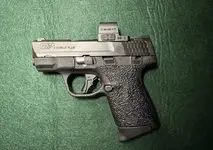
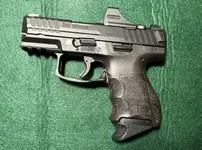
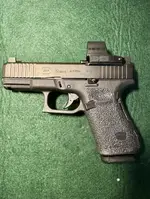
I'll give you some examples (all 3 are in the photographs attached to this post):

Factory direct mounts: The Shield Plus OR has a K cut footprint and comes with iron sights that achieve acowitness on many mainstream optics including the Osight SE, Holosun 407k/507k etc. Pictured is a Shield Plus OR w/ the Osight SE.

Holosun SCS: Pretty much all of the guns with proprietary slide cuts that Holosun made SCS versions for cowitness with stock irons because they are direct mount and the deck height is low. So the Glock MOS, M&P CORE, VP9 etc. Pictured is the VP9SK with a Holosun SCS.

Suppressor height sights: Adding trijicon or whatever other suppressor height sights to your gun will allow you to cowitness with optics that sit on plates. Pictured is a Glock 19.5 with a Calculated Kinetics Dog Tag, Trijicon suppressor height sights, and an Osight XE.

If the dot were to fail on any of these guns I will still have sights.
 

Attachments

  • 1788032621364.webp
    1788032621364.webp
    155.1 KB · Views: 7
  • 1788032637473.webp
    1788032637473.webp
    185 KB · Views: 7
  • 1788032682931.webp
    1788032682931.webp
    184.8 KB · Views: 7
For you RDS guys...do you have em 3" and 3.5" and 4" slides? Does the size make any difference? I carried full size sidearms most of the time but now prefer the smaller weapons.
 
For you RDS guys...do you have em 3" and 3.5" and 4" slides? Does the size make any difference? I carried full size sidearms most of the time but now prefer the smaller weapons.
Slide length is irrelevant. There isn't really a "sight radius" consideration like there is with irons. With a red dot, the dot is projected onto the target plane, so the differences between handgun sizes is mostly going to come down to overall size, weight, balance, etc.

I think it's crazy people are putting optics on BG2.0s, which imo is meant to be as small of a package as possible for pocket carry, but outside of that, dot away.
 
I don’t see how the length of slide has an impact on “effectiveness” you will have improved accuracy and follow up speed regardless. The glass on BG 2.0 pebble is quite small so it is not forgiving when it comes to lack of consistency in presenting sight picture. When it comes to BG. I would almost argue it’s a disadvantage for those who train less often with it.
 
I have always rejected "tech requiring a battery" over iron sights because I figure function in a life & death situation is the priority. That said, I placed DeltaPoint RDS optics on two sidearms I wear open carry in the backcountry when bowhunting, a Glock G22 and G40 in the oft chance I see a large predator charging...it provided "some" advantage, especially with the 10mm at distances between 40-100 yards. I got comfortable practicing with both irons & RDS. Still only use irons on my CCW sidearms.

BUT as my eyes (and the rest of me) age...I am reconsidering this. So I did an hour at Artemis Defense on their 300 degree digital platform using the same sidearm (pneumatic G22) with and without RDS on moving targets. (It was easier than live fire shooting and provided me an instant scoring and review using both.)

After running a series of programs, my results using the RDS was SLIGHTLY BETTER than irons. Mostly at longer ranges and where motion and/or time stress was in place...the differences were too slim IMO to matter. That said, I ask this question from those who actually know:

In an actual gunfight (where your life is on the line) is the slimmest benefit in accuracy enough to justify the risks of an optic failure?

For Law Enforcement it's different because they draw their weapons in pursuit...CCW holders are far less likely to do this and chasing/corralling armed felons is not a civilians job so what's good for cops isn't necessarily good for Average Joe. I am particularly interested in hearing from those who train others in SD and have advanced tactical experience with Iron and RDS sights.

Secondly, if you were going to add an RDS to a CCW sidearm and had to choose between a full size, compact and/or subcompact Glock...how would you select? All are the same caliber (.40) and which piece I carry often depends on what I'm wearing, where I'm going and a general risk assessment. Thank you for your professional input. I am fully centered on the fence and eagerly await your opinions. :-)

Many US LE agencies are moving to red dot, and they're standard issue for most whiteside SOF and have been in use by special mission units for years. This is for both overt carry in battlefield conditions and concealed carry in plainclothes - I'd say all of the above is a pretty good indicator of how optics equipped pistols perform in "actual gunfights". If you peruse the open source body cams floating around on social media, we're also seeing an uptick of RDS pistols being used in officer-involved shootings.
 
Many US LE agencies are moving to red dot, and they're standard issue for most whiteside SOF and have been in use by special mission units for years. This is for both overt carry in battlefield conditions and concealed carry in plainclothes - I'd say all of the above is a pretty good indicator of how optics equipped pistols perform in "actual gunfights". If you peruse the open source body cams floating around on social media, we're also seeing an uptick of RDS pistols being used in officer-involved shootings.

Thanks for that. I presume LEOs prefer em because they are much more likely to be called into a situation wherein they enter with guns drawn and engage bad guys from a distance whereas a CCW civilian is far less likely to find himself (or herself) in a comparable situation. I'm the "less is more" kinda guy but may get a second slide w/ optic so I can adapt to whatever travels come my way.
 
Back
Top Bottom