18+ Content Warning

By clicking Enter, you confirm you are 18 years of age or older and agree to comply with all applicable local, state, and federal laws.

Notice: Any content or member activity - including anything you may buy, sell, transfer, or discuss - must comply with current and upcoming laws.

Members are encouraged to stay informed: California Firearm Laws: 2026 Outlook & 2025 Recap . Responsibility for compliance rests solely with the individual member.

caguns.net

Welcome to CAguns.net!
Join our growing community where you can ask questions, share knowledge, or browse our classifieds section.

Sign up for a free account today and unlock full access! Once registered, you can search, post, and take advantage of exclusive features unavailable to guests.

A note on why more of the site now requires an account: automated scrapers and AI systems have been crawling our forums and classifieds at a scale. Requiring sign-in for those sections is the most effective tool we have. It takes a minute to register, it's free, and it keeps what happens here between actual members.

New to California gun ownership or trying to keep up with the changing laws? Check out our sister site CA2A.com — free courses, plain-English legal updates, and step-by-step guides built for California owners.

Advanced features are available only to registered members. Register today!

Need help: T10 bit broke inside screw

I remove stuck screws all the time.
The first rule when you break off anything trying to remove a screw is to stop messing with it and making it worse.
Heat is always your friend when a screw wont come out as easy as you expect it to.

After you have already broken off a piece of tool steel in a screw, stop and get it to someone with a milling machine and carbide tooling.
I have drilled right down the middle of lots of pieces of broken off allen bits, torx bits, drill bits, screw extractors that people stuck in a screw trying to do it themselves.
After the screw head is removed, you can remove whatever part the screw is holding and you have much better access to the rest of the screw that will be sticking up from whatever it's threaded into.
The remaining screw shank will often unscrew without any problem, even if it's loctited, if you get it hot.
 
Hi,

I have a T10 screw that is screwed on to the point where it broke my bit while trying to unscrew it. This came from the factory (thanks, Ruger) like this and it's the last screw I would like to remove.

This screw is located on the rear sight just under the ghost ring.

Any help would be greatly appreciated. I'm located in SF, hopefully someone close by will have better tools or skills to help me tackle this T10 screw.
I had this happen not too long ago, i was able to tap it loose with a set of small flathead screw drivers similar to what you would use for eye glasses. Tap it in the opposite direction that you were going. Have a strong magnet from home depot on standby if you can .
 
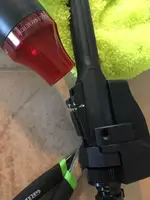
Everyone had all these great tips about how to resolve the issue I posted about. I wanted to thank you guys by showing you that I did the complete opposite. Lol. Not by choice but by sear ignorance, lack of patience, lack of preparation, and lack of knowledge.

To anyone facing this issue in the future, please do your due diligence. I got lucky and everything worked out, you might not be so lucky.
 

Attachments

  • mmexport1767285570582.webp
    mmexport1767285570582.webp
    33.3 KB · Views: 5
Everyone had all these great tips about how to resolve the issue I posted about. I wanted to thank you guys by showing you that I did the complete opposite. Lol. Not by choice but by sear ignorance, lack of patience, lack of preparation, and lack of knowledge.

To anyone facing this issue in the future, please do your due diligence. I got lucky and everything worked out, you might not be so lucky.
Heat guns are way too slow and end up heating up everything because they take so long to heat a specific spot that the heat travels all through the part you are heating.
What you want to use is a propane torch.
A torch puts out a LOT more heat so you can quickly heat up a spot before the whole part gets hot.
You generally want to get to just a little over 400 degrees F.
The easiest way to tell you are at 400 is that most oils will generate smoke above 380 to 410 degrees.
So wipe the part down with an oily rag before you start heating it.
The oil will not appear while the flame is lapping on the part so you heat 3-5 seconds and then remove the torch to look for smoke.
If there's no whif of smoke, reapply the torch another 3 seconds and check again.
Repeat this until you get a little whif of smoke when you remove the torch and then you have found about 400 degrees.
Very few loctite grades survive above 400 degrees.

If you are doing this on a pistol slide or anything with springs or plastic parts, remove the plastic and the springs before you begin.
 
Back
Top Bottom