

- Messages
- 18
I encountered this problem a few months ago when fireforming my first round of brass for 6.5x55 Ackley Improved (with 40* shoulder). Now that I will be getting around to fireforming another batch, I want to see if anyone has some suggestions.
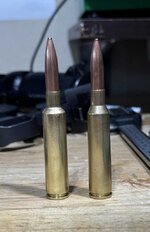
Loaded cartridge pictured next to its parent cartridge (6.5x55 Swedish):
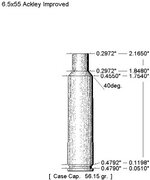
Cartridge drawing:
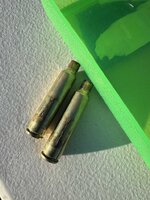
When I did the initial batch of fireforming for the new Ackley cartridge, approximately 10% of the Hornady cases would split longitudinally near the base, as pictured:
Fortunately, I always wear eye protection. However, I didn’t notice it as it occurred, and only noticed the failures when picking up the brass later. (I inspected only my first five or so cases before firing the rest rapidly.) Perhaps Tikkas have good gas mitigation.
Importantly, this failure only occurred with Hornady cases. PPU brass is apparently not prone to this failure.
I cut the chamber on a lathe using a custom reamer, from a standard 6.5x55 chamber, then moved the shoulder back until the chamber was .002” shorter than minimum SAAMI spec for a standard 6.5x55. (This practice is often recommended for Ackley conversions, to hold the unmodified cartridges more securely.) With fire formed brass, the fired cartridges still conform to the drawing, resizing does not move the shoulder back, as the chamber was cut short. Bolt does not require excess pressure to close with either the parent or fireformed case. I’m pretty confident in the chamber.
For the fireforming load, I use a heavy for caliber bullet (140 gr), with a light to moderate load of a fast for cartridge powder (Varget or IMR 4895). I’ve confirmed these loads with QuickLoad, which reports that they will produce pressure early, but with peak pressures in the safe range. These loads tend to underperform if anything, chronographing on slow end. With the thick PPU brass about 10-15% of cases do not fully form (and come out sooty), and need to be fireformed again. The problem of incomplete forming did not occur with Hornady brass.
Again, the issue there with with the case splits.
I think the underlying problem is with the Hornady brass. I know Hornady runs thin. However, the fact that they’re splitting at the base, rather than near the shoulder (where the bulk of expansion is occurring) is odd.
I’ve heard that American made 6.5x55 brass (like Hornady) is often undersized at the base and rim to fit more standard .473” bolts. The fired and unsized brass does indeed measure .473” at the rim, but a near perfect .479” at the base (same as the PPU brass). I do not have any unfired Hornady 6.5x55 cases to measure for comparison. So, perhaps they are about .006” or so undersized. That hardly seems like enough, though, to cause the split.
With the successfully formed Hornady brass, it behaves normally. Requires little to no trimming, and holds up well. I’ve got 6 loads on most of the cases.
Could it really just be poorly designed Hornady brass, with the undersized bases expanding quickly to the correctly sized chamber? If so, why don’t I get the same problem with Hornady brass in a standard 6.5x55 chamber, especially an oversized chamber in a Swedish military rifle? Should I take a chamber cast?
My next batch of brass is probably going to Lapua cases. But I wanted to get some opinions first. Thanks in advance.
Loaded cartridge pictured next to its parent cartridge (6.5x55 Swedish):
Cartridge drawing:
When I did the initial batch of fireforming for the new Ackley cartridge, approximately 10% of the Hornady cases would split longitudinally near the base, as pictured:
Fortunately, I always wear eye protection. However, I didn’t notice it as it occurred, and only noticed the failures when picking up the brass later. (I inspected only my first five or so cases before firing the rest rapidly.) Perhaps Tikkas have good gas mitigation.
Importantly, this failure only occurred with Hornady cases. PPU brass is apparently not prone to this failure.
I cut the chamber on a lathe using a custom reamer, from a standard 6.5x55 chamber, then moved the shoulder back until the chamber was .002” shorter than minimum SAAMI spec for a standard 6.5x55. (This practice is often recommended for Ackley conversions, to hold the unmodified cartridges more securely.) With fire formed brass, the fired cartridges still conform to the drawing, resizing does not move the shoulder back, as the chamber was cut short. Bolt does not require excess pressure to close with either the parent or fireformed case. I’m pretty confident in the chamber.
For the fireforming load, I use a heavy for caliber bullet (140 gr), with a light to moderate load of a fast for cartridge powder (Varget or IMR 4895). I’ve confirmed these loads with QuickLoad, which reports that they will produce pressure early, but with peak pressures in the safe range. These loads tend to underperform if anything, chronographing on slow end. With the thick PPU brass about 10-15% of cases do not fully form (and come out sooty), and need to be fireformed again. The problem of incomplete forming did not occur with Hornady brass.
Again, the issue there with with the case splits.
I think the underlying problem is with the Hornady brass. I know Hornady runs thin. However, the fact that they’re splitting at the base, rather than near the shoulder (where the bulk of expansion is occurring) is odd.
I’ve heard that American made 6.5x55 brass (like Hornady) is often undersized at the base and rim to fit more standard .473” bolts. The fired and unsized brass does indeed measure .473” at the rim, but a near perfect .479” at the base (same as the PPU brass). I do not have any unfired Hornady 6.5x55 cases to measure for comparison. So, perhaps they are about .006” or so undersized. That hardly seems like enough, though, to cause the split.
With the successfully formed Hornady brass, it behaves normally. Requires little to no trimming, and holds up well. I’ve got 6 loads on most of the cases.
Could it really just be poorly designed Hornady brass, with the undersized bases expanding quickly to the correctly sized chamber? If so, why don’t I get the same problem with Hornady brass in a standard 6.5x55 chamber, especially an oversized chamber in a Swedish military rifle? Should I take a chamber cast?
My next batch of brass is probably going to Lapua cases. But I wanted to get some opinions first. Thanks in advance.
Last edited:
