18+ Content Warning

By clicking Enter, you confirm you are 18 years of age or older and agree to comply with all applicable local, state, and federal laws.

Notice: Any content or member activity - including anything you may buy, sell, transfer, or discuss - must comply with current and upcoming laws.

Members are encouraged to stay informed: California Firearm Laws: 2026 Outlook & 2025 Recap . Responsibility for compliance rests solely with the individual member.

caguns.net

Welcome to CAguns.net!
Join our growing community where you can ask questions, share knowledge, or browse our classifieds section.

Sign up for a free account today and unlock full access! Once registered, you can search, post, and take advantage of exclusive features unavailable to guests.

A note on why more of the site now requires an account: automated scrapers and AI systems have been crawling our forums and classifieds at a scale. Requiring sign-in for those sections is the most effective tool we have. It takes a minute to register, it's free, and it keeps what happens here between actual members.

New to California gun ownership or trying to keep up with the changing laws? Check out our sister site CA2A.com — free courses, plain-English legal updates, and step-by-step guides built for California owners.

Advanced features are available only to registered members. Register today!

Emergency radio classes on So Cal?

Very cool. I used to want to test for HAM, but is there anything more updated now? Does GMRS replace it these days?
No, GMRS does not replace HAM.

 
There are a lot of good and cheap handheld, GMRS specific radios, boafeng and tidradio). 50 watts is the max for GMRS. Rocky Talkies are expensive but get great reviews.

Midland makes some good mobile units. To extend your range at home, you can purchase a repeater.


See this guy’s comments.

 
No, GMRS does not replace HAM.

Indeed, GMRS does not replace HAM, but it is cost effective radio platform for shorter range voice communication. If you are looking for a radio to stay connected with local family members or neighbors during an emergency -- when electricity, internet, and cell phone towers go down (fires, earthquakes, hurricanes, bad actors, etc) -- GMRS fits the bill. GMRS has been widely adopted by 4 x 4 clubs; outdoor enthusiasts; and proactive neighborhood groups, like FEMA backed CERTs (Community Emergency Response Teams).

One benefit of a GMRS license/call sign is that it can be used by family members. A lot of GMRS hand held radios are sold in packets of 2 - 4 radios.

If you are thinking of getting a HAM license, GMRS might be a good place to start. Consider it the radio version of a 22 lr rifle. Plink with it for awhile. If you need to reach out and touch someone farther out, there are a lot of off-the-grid communication options available: Starlink, Garmin InReach devices, semaphore. HAM radio is just one of them.
 
Indeed, GMRS does not replace HAM, but it is cost effective radio platform for shorter range voice communication. If you are looking for a radio to stay connected with local family members or neighbors during an emergency -- when electricity, internet, and cell phone towers go down (fires, earthquakes, hurricanes, bad actors, etc) -- GMRS fits the bill. GMRS has been widely adopted by 4 x 4 clubs; outdoor enthusiasts; and proactive neighborhood groups, like FEMA backed CERTs (Community Emergency Response Teams).

One benefit of a GMRS license/call sign is that it can be used by family members. A lot of GMRS hand held radios are sold in packets of 2 - 4 radios.

If you are thinking of getting a HAM license, GMRS might be a good place to start. Consider it the radio version of a 22 lr rifle. Plink with it for awhile. If you need to reach out and touch someone farther out, there are a lot of off-the-grid communication options available: Starlink, Garmin InReach devices, semaphore. HAM radio is just one of them.

Agree
 
GMRS is not ham, but ham is not what it used to be.
Communication is a skill, and GMRS radios are one way to communicate. Structure is needed for *effective* communication.
I suggest taking the FEMA courses on emergency prep, the NICS/NIMS courses. They provide key background structure for
how others (throughout the US) expect to communicate in the field, and how communication can be made effective.

KF6JGX -- Ham radio Extra, and owner of various band-modified radios from various makers.
 
I would echo the recommendations you reconsider amateur radio. There's a lot more to good emergency radio comms beyond protocols and programming/operating something like a GMRS/FRS. A Tech license gives you a lot of good knowledge of improvising antennas of various kinds, operating on backup power, frequencies likely to be monitored in your area, handling traffic for others, etc. Plus then you can get training and practical experience through RACES and ARES - including in such helpful technologies as INVIS and (yep) GMRS, interfacing with official information sources (e.g. police, fire, municipal, medical), etc.
 

If you find a gmrs radio where you can program in the 4 MURS channels, that might be a good way to communicate with others. No license is needed, like FRS channels.


The Multi-Use Radio Service (MURS) uses channels in the 151 – 154 MHz spectrum range. The most common use of MURS channels is for short-distance, two-way communications using small, portable hand-held radios that function similar to walkie-talkies.

Similar services include General Mobile Radio Service (GMRS) and Family Radio Service (FRS).

MURS is authorized five channels that were previously in the industrial/business radio service and were known as the “color dot” frequencies in Part 90 of the FCC rules.
 
Check out “ham radio crash course” on YouTube. It’s focused on ham but there are a lot of good informational video including some focused on emergency radio use.
Also, be REALLY careful with beofeng radios. Many of them are completely unlocked. That means they will broadcast and receive on any channel. That includes air traffic control, military, police, fire. If you don’t know what you are doing it would be really easy to accidentally break a lot of laws or potentially cause a lot of harm to rescue operations during an emergency.
Case in point. Some one was just fined quite a bit for transmitting on a Fire AtoG frequency. It was intentional and this guy should have known better but it shows what can happen when you play with radios you aren’t licensed for.
Ham Radio Crash Course
 
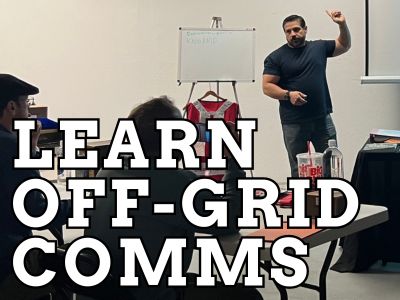
Hey, that’s our class; we’re doing it again on Jan 25. If you have any questions, feel free to contact me.

 
I meet a lot of people who think the getting your license piece is bull💩 and that they won't need it. In my extensive experience - you need to constantly practice / make contacts and QSO's with your radio in various areas you plan to use it - can you hit the repeaters? If not, can someone offer you help? The HAM community while seemingly bland and appealing to a much older audience, is very friendly and eager to help new operators use their equipment successfully. It's in everyone's best interest.

Just get the license, train yourself and when you really need to use that radio, you hopefully won't have issues communicating.
 
I have had my ham license for many years and am active in a international radio network that is well covered in CA. Mostly So Ca and SF Bay... As well as a mix of the US and several countries.

Of course they are linked by the Internet, but a simple handheld radio and access to a local repeater gets you into the network. $25 radio and you can talk to someone in Europe, Japan, Israel.... So on.
 
Amateur Extra here in L.A. Ham community are some of the friendliest and helpful people I have met. Though there is a big age gap, talking with the old timers they have tremendous knowledge and are very willing to help people. I've learned a whole lot just CQing and chatting with good people. There is so much to learn it can be overwhelming, but slow and steady you will learn the basics and become a solid operator in no time.
 
Anyone know of any emergency radio communication classes in So Cal? I found one in El Cajon next weekend, but it's a long as drive and short notice, so not sure I can make it. I am not really looking for a HAM radio class, but of a Baofang type radio class. Or if anyone could recommend some good youtube videos. I have my radios programmed with chirp, but have never actually used the dam things. After the happenings in NC, I figure I should learn how.
Amatuer radio licensing these days is a breeze as there are no longer any code requirements. I've held an Extra class license for decades and earned it back in the days of CW requirements. For the Baofeng HT type radios all you would need would be a technician license which allows you to use the 2 meter, 220mhz and 440mhz bands (and higher). There isn't anywhere near as much activity on these bands as there used to be but, a good repeater with a generator backup and an emergency landline phone patch system can be a real lifesaver in most emergencies short of an EMP attack. There is nothing to say that the Ham repeaters are going to be any more survivable than the cell sites in an emergency but they can provide a better perspective on events than the singular nature of a cell phone call.

Additionally, Baofeng is also selling a class of radio designed to transmit in the GMRS spectrum, which has very little traffic so far and not a lot of repeaters. GMRS licensing is only about $35 with no test requirements.

If you are looking for a longer range and more apocalypse-oriented communications system, consider testing for a General class Amatuer license that will allow you to use the shortwave bands with global communication potential. Obviously this is a more expensive investment in time and equipment. However, the likelihood of any of this modern technology functioning in the wake of an EMP attack is nil. For that kind of preparedness, you would have to equip yourself with vacuum tube transmitters and receivers.

One really nice thing about Ham radio is the spectrum is governed by federal law meaning that your first amendment protections are far greater (currently) than on privately held websites or other privately owned services. There are rules and regulations but they are far less capricious then one might find on the internet.
 
Back
Top Bottom