
- Messages
- 317
Yeah, they flipped recently and would no longer defend the ban. Even if they weren't a party, their statements of interest are usually persuasive.The US DOJ was a defendent in the lawsuit
Last edited:
By clicking Enter, you confirm you are 18 years of age or older and agree to comply with all applicable local, state, and federal laws.
Notice: Any content or member activity - including anything you may buy, sell, transfer, or discuss - must comply with current and upcoming laws.
Members are encouraged to stay informed: California Firearm Laws: 2026 Outlook & 2025 Recap . Responsibility for compliance rests solely with the individual member.

Welcome to CAguns.net!
Join our growing community where you can ask questions, share knowledge, or browse our classifieds section.
Sign up for a free account today and unlock full access! Once registered, you can search, post, and take advantage of exclusive features unavailable to guests.
A note on why more of the site now requires an account: automated scrapers and AI systems have been crawling our forums and classifieds at a scale. Requiring sign-in for those sections is the most effective tool we have. It takes a minute to register, it's free, and it keeps what happens here between actual members.
New to California gun ownership or trying to keep up with the changing laws? Check out our sister site CA2A.com — free courses, plain-English legal updates, and step-by-step guides built for California owners.
Advanced features are available only to registered members. Register today!

Yeah, they flipped recently and would no longer defend the ban. Even if they weren't a party, their statements of interest are usually persuasive.The US DOJ was a defendent in the lawsuit
This does create an interesting conflict with Hanson (Circuit Court of Appeals) on 11+ mag bans. Hanson said DC could ban the mags, Benson says DC cannot.In the federal court of appeals, in particular the 9th circuit. The question we are discussing here is the DC court of appeals, which is NOT a federal circuit court. The District of Columbia is today more like a state than like the federal government, as far as having an AG and its own court system is concerned (although only "more like" and "not completely identical to").
 2025 CAguns Supporter
 10+ Feedback!
 Top Feedback Leaver
 CAguns Supporter
If only there was a way to resolve conflicts in interpretation.....This does create an interesting conflict with Hanson (Circuit Court of Appeals) on 11+ mag bans. Hanson said DC could ban the mags, Benson says DC cannot.
If only there was a way to resolve conflicts in interpretation.....
 . If only...
From Footnote #1 of the Decision (emphasis mine):The United States Court of Appeals for the District of Columbia Circuit (in case citations, D.C. Cir.) is one of the thirteen United States Courts of Appeals. It has the smallest geographical jurisdiction of any of the U.S. courts of appeals, and it covers only the U.S. District Court for the District of Columbia.
Decisions of the D.C. Circuit have been appealed to SCOTUS in the past (See: District of Columbia, et al. v Heller.). For recent comparisons, SCOTUSBlog in 2025 reported (https://www.scotusblog.com/2025/07/by-the-numbers/):This court’s rules require that the District be provided notice of any appeal
raising a challenge to “the constitutionality of an act of the Council of the District of
Columbia,” like the present Second Amendment challenge to the District’s ban on
11+ magazines. D.C. App. R. 44(b). After receiving that notice, the District
expressly sought to intervene “as an appellee” in this appeal. Both Benson and the
United States consented to its party status, and this court granted its motion “to
intervene as an appellee.
The District is thus a party, and has all the rights of a
party, in this appeal. That includes the right to petition for rehearing, rehearing en
banc, or certiorari in response to this opinion.
It should be noted that the 9CA has about a 10-fold greater caseload than the DC CA. Ballotpedia also has a breakdown of cases submitted to all federal appellate courts here: https://ballotpedia.org/Supreme_Court_cases,_October_term_2024-2025#Cases_by_circuitOf the 56 decisions in 2025, 12 or about 20%, were reviewing the United States Court of Appeals for the 5th Circuit. By comparison, the next most frequent were eight decisions reviewing the U.S. Court of Appeals for the 4th Circuit, seven decisions reviewing the U.S. Court of Appeals for the 9th Circuit, and five reviewing the U.S. Court of Appeals for the District of Columbia Circuit.
For more fun, consider this Wikipedia: https://en.wikipedia.org/wiki/District_of_Columbia_Court_of_AppealsFor fun….
Hemani and Duncan are not very closely related. The first issue in Duncan is almost identical to the that of Benson. If I remember correctly, Duncan came to a different factual finding about both whether magazines are considered "arms" under the 2A and whether they are in common use for self-defense in the US.For more fun, consider this Wikipedia: https://en.wikipedia.org/wiki/District_of_Columbia_Court_of_Appeals
There is both a United States Court of Appeals for the District of Columbia Circuit and a District of Columbia Court of Appeals. And they are separate. The former is a federal court (just like the 9th circuit), as you explained. The second one is ... different. Not really a state supreme court, but also definitely not a federal court.
And I agree with everything else you said. It is quite possible that SCOTUS has been holding Duncan because they knew that Benson was coming. It is also possible that they were holding it until they know their own decision in the recent marijuana 2A case (whose name I have already forgotten). It is also possible that they are holding it simply because they haven't had time to come to a conclusion about what to do with it, and document that. Or something else. Or a combination of things.
The problem with Benson versus Duncan is that the Duncan decision states magazines are not arms. Benson says they are. SCOTUS could move ahead with Duncan and resolve that question foreclosing a need to review Benson. So why wait for Benson?For more fun, consider this Wikipedia: https://en.wikipedia.org/wiki/District_of_Columbia_Court_of_Appeals
And I agree with everything else you said. It is quite possible that SCOTUS has been holding Duncan because they knew that Benson was coming.
But why did the Court accept Hemani? There are folks around who think that SCOTUS is too darn busy to waste time with trivial firearms issues like Duncan, and yet the Court took a case to determine whether a marijuana smoker can have access to firearms. I haven’t polled anybody but I doubt that issue is top of mind for a vast section of the nation. But, perhaps the Court recognizes that the 2A isn’t a second class right and resolving issues of national practice has relevance today. Perhaps, when the Solicitor General weighs in, the case gets more credence?It is also possible that they were holding it until they know their own decision in the recent marijuana 2A case
I’m back with you.Or something else. Or a combination of things.
My theory: Both adrkwan and you are way to deep in the weeds of the technicalities of 2A jurisprudence. My suspicion (without any proof!) Is that the justices are looking at a much more fundamental issue: How are others courts using the new Bruen framework and rules? Is Bruen working, or does it need to be refined?But why did the Court accept Hemani?
And I'm one of those folks. Which is why I think Hamani is about another balance of power issue, not about smoking weed or shooting guns. P.S. Thank you for reminding me that the case is called Hamani. Next question: Anyone know who this Alzheimer fellow is?There are folks around who think that SCOTUS is too darn busy to waste time with trivial firearms issues ...
At this juncture, it could also be the opposite. The federal government hasn't had a particularly good track record in the court in the last year or so.Perhaps, when the Solicitor General weighs in, the case gets more credence?
At my age I believe that if you remember you forgot something you’re OK.P.S. Thank you for reminding me that the case is called Hamani. Next question: Anyone know who this Alzheimer fellow is?

Does this mean they snoozed on Duncan one more time?9 Mar: Orders don’t appear to include Duncan (Case # 25-198).
Yes.Does this mean they snoozed on Duncan one more time?

They now need to discuss the split between the 9th Circuit and the D.C. Circuit, and possibly consider the likely appeal from the District of Columbia after last week’s decision in Benson.Does this mean they snoozed on Duncan one more time?
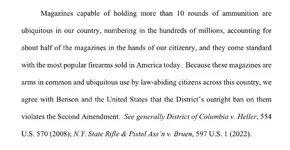
They now need to discuss the split between the 9th Circuit and the D.C. Circuit, and possibly consider the likely appeal from the District of Columbia after last week’s decision in Benson.
View attachment 162806
https://www.dccourts.gov/sites/default/files/2026-03/Benson v US et al 23-CV-0541 FINAL.pdf

See:It's not a circuit split. It's the DC Court of Appeals. Likely to go en banc.
Yup, that's the U.S. Court of Appeals for the District of Columbia Circuit (https://www.cadc.uscourts.gov/) that authored the Hanson decision earlier. The Benson decision was authored by the D.C. Court of Appeals (https://www.dccourts.gov/court-of-appeals) which is the functional equivalent of every other state's Supreme Court. Whoever decided on the naming convention for the Courts did a horrible job.See:
Federal Judicial Circuits: District of Columbia Circuit | Federal Judicial Center
Includes landmark legislation, congressional committees, appropriations, administrative agencies, court officers and staff…www.fjc.gov
IrregularDefense is correct. The decision in Benson is not from the federal court circuit for DC; it is from the DC appeals court, which is like a "state supreme court" for the "state" of DC. Yes, I know the naming of these two courts is terribly confusing. Also, Benson has not exhausted its lower court proceedings, as IrregularDefense also said, as it can still be appealed in the same DC appeals court by going en bank. So it is premature for the SCOTUS (Supreme Court of the United States) to take it up.See:
Federal Judicial Circuits: District of Columbia Circuit | Federal Judicial Center
Includes landmark legislation, congressional committees, appropriations, administrative agencies, court officers and staff…
Welcome to CAguns.net!
Hello There! I see you're browsing as a guest. Sign up to use our regional search features and communicate with other members.
Registering is quick and free. Once registered, you’ll unlock exclusive features available only to members. Join today!
If you choose to become a contributor, you'll get even more advanced features.📸 We're now on Instagram! Follow us @caguns_net and tag us in your videos and photos to get featured!
