

18+ Content Warning

By clicking Enter, you confirm you are 18 years of age or older and agree to comply with all applicable local, state, and federal laws.

Notice: Any content or member activity - including anything you may buy, sell, transfer, or discuss - must comply with current and upcoming laws.

Members are encouraged to stay informed: California Firearm Laws: 2026 Outlook & 2025 Recap . Responsibility for compliance rests solely with the individual member.

caguns.net

Welcome to CAguns.net!
Join our growing community where you can ask questions, share knowledge, or browse our classifieds section.

Sign up for a free account today and unlock full access! Once registered, you can search, post, and take advantage of exclusive features unavailable to guests.

A note on why more of the site now requires an account: automated scrapers and AI systems have been crawling our forums and classifieds at a scale. Requiring sign-in for those sections is the most effective tool we have. It takes a minute to register, it's free, and it keeps what happens here between actual members.

New to California gun ownership or trying to keep up with the changing laws? Check out our sister site CA2A.com — free courses, plain-English legal updates, and step-by-step guides built for California owners.

Advanced features are available only to registered members. Register today!

Question DQ'd for shooting steel under 7yds: fair or poor stage design?

Messages
779
Classified ads
2
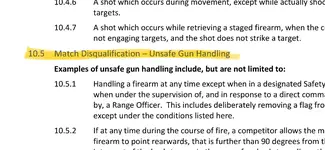
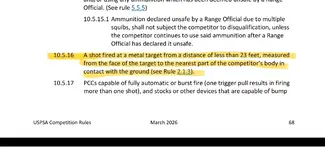
This guy was DQ'd for a make up shot on steel within 7yds (23 feet).
The rule itself is established as it's a safety risk.

Is this a "fair" DQ (shooter responsibility)?
Should responsibility fall on the the stage design or match director to avoid this?

 
Last edited:

I believe this rule may apply but I'm not sure 100% if it applies to steel. It's definitely on the stage designer not to have dq traps but also shooting steel through a little window is pretty dumb. You can't break safety rules just because the stage had a trap.

 
After you take a few “frags” ricochets from steel targets you start to appreciate the rules more.

Even when we were training further out, poorly designed (not tilted down steel targets) etc will produce ricochets. Have taken a few to soft vests and while not life threatening, you know you got hit. Would suck more in face or hands, etc.
 
Both. Steel shouldn’t be available from that distance. A barrel would have closed that stage design flaw.

Also on the shooter for shooting at steel that close. Know the rules. “If you can see it, you can shoot it” has sent many a shooter out for ice cream early.
 
I agree with the post above. It's both. Stage design should have blocked it, but he also should know you don't shoot steel from that distance or angle. He looks like he's probably done this a few times, so it's not like he's a new shooter.
 
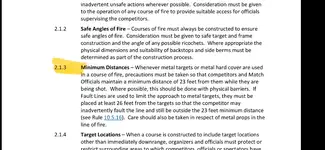
Absolutely a DQ. It’s a general safety rule, it’s frequently a range safety rule and its organized competition safety rule (IDPA 2.14, USPSA 2.1.3).

You get someone running a 38 supercomp, 38 special, 357 mag, 9 major, 9 +P or even some hotter 9mm minor handloads and you’ll get some serious fragmentation and splash even at 10yrds or more. I’ve been hit numerous times on the top of the head and legs from fragmentation. It’s only because we had steel set far enough away that it didn’t break skin.

In general, we bake the warning into our stage designs and verbally warn in our walk-through but the general expectation is that you know the rules and you are responsible.

And no it is absolutely NOT the range’s responsibility NOR is it the stage designer’s responsibility to make sure you are shooting safely. It is ENTIRELY your responsibility as the one with your finger on the trigger.

If you have doubts about the safety of a stage, ask questions BEFORE anyone starts shooting the stage. Call out anything you think is a safety issue. No one should grief you for wanting to be safe
 
Last edited:
It's a Level 2 USPSA match so competitors should expect better than average stage design. We don't have the stage briefing, if it said ~'shoot steel from xxxx' there's nothing to complain about. If it said ~'engage targets as available', they done you wrong with the DQ.
 
It's a Level 2 USPSA match so competitors should expect better than average stage design. We don't have the stage briefing, if it said ~'shoot steel from xxxx' there's nothing to complain about. If it said ~'engage targets as available', they done you wrong with the DQ.
Disagree. I am not even a competitive shooter but simply watching the video. Shooting a steel on that manner was reckless
 
It's a Level 2 USPSA match so competitors should expect better than average stage design. We don't have the stage briefing, if it said ~'shoot steel from xxxx' there's nothing to complain about. If it said ~'engage targets as available', they done you wrong with the DQ.
Just because you don’t have a briefing doesn’t mean you aren’t responsible for reading the rules and being safe. If anything, a level 2 match should mean every shooter and RO there should know better than to engage closer than safe.
 

Attachments

  • IMG_3690.webp
    IMG_3690.webp
    57.3 KB · Views: 7
  • IMG_3691.webp
    IMG_3691.webp
    50.7 KB · Views: 7
  • IMG_3692.webp
    IMG_3692.webp
    36.8 KB · Views: 7
Is that not also a violation for shooting under a wall as well? I know it is missing part of the wall, but a wall none the less?
Walls extend to infinity as hard cover in vertical directions. It wouldn't be a DQ just for that (since there was actually an exposed target) but the steel would be scored as FTSA, unless otherwise stated in the stage brief (I think).
 
Absolutely a DQ. It’s a general safety rule, it’s frequently a range safety rule and its organized competition safety rule (IDPA 2.14, USPSA 2.1.3).

You get someone running a 38 supercomp, 38 special, 357 mag, 9 major, 9 +P or even some hotter 9mm minor handloads and you’ll get some serious fragmentation and splash even at 10yrds or more. I’ve been hit numerous times on the top of the head and legs from fragmentation. It’s only because we had steel set far enough away that it didn’t break skin.

In general, we bake the warning into our stage designs and verbally warn in our walk-through but the general expectation is that you know the rules and you are responsible.

And no it is absolutely NOT the range’s responsibility NOR is it the stage designer’s responsibility to make sure you are shooting safely. It is ENTIRELY your responsibility as the one with your finger on the trigger.

If you have doubts about the safety of a stage, ask questions BEFORE anyone starts shooting the stage. Call out anything you think is a safety issue. No one should grief you for wanting to be safe
The RO was right to DQ - leave it up to MD to make the final call.

Nonetheless, that design is dangerous and should've been covered, had minimum distance marker or thrown out.

That's not just poor, that's dangerous design.
 
Walls extend to infinity as hard cover in vertical directions. It wouldn't be a DQ just for that (since there was actually an exposed target) but the steel would be scored as FTSA, unless otherwise stated in the stage brief (I think).

I agree, so even taking that shot, even on paper should have been a no go. I guess if you don't know one rule, good chance you don't know several.

If it was paper and shot under the wall, it should be a miss via 2.2.3.2 and if steel with legal distance, 2.2.3.3. (If I am reading it correctly.)
 
I agree, so even taking that shot, even on paper should have been a no go. I guess if you don't know one rule, good chance you don't know several.

If it was paper and shot under the wall, it should be a miss via 2.2.3.2 and if steel with legal distance, 2.2.3.3. (If I am reading it correctly.)
There are many, many rules and they change. That's why it's so important to go to the rule book.

Unless you run NROI trainings or regularly RO at major matches (some folks live in the rulebook) there can be A LOT of things that get missed. Especially, those rules that you rarely come across.

For a competitor, 99.999% of the steel you shoot is at safe distance by stage design. You'd have to cross fault lines or otherwise just to break those rules.

In the heat of the moment I can see myself potentially shooting that steel in this particular scenario. I’ve yet to encounter exposed steel without a clear fault, barrier or minimum safe distance marker. So by habit I could’ve easily engaged that popper, thinking I’m safe in the shooting zone.

I sympathize with the shooter, commend the RO and blame the stage designer and MD for a dangerous design.
 
Last edited:
I remember my shooting steel at pretty close, probably ten yards and getting a tiny nick on my neck from spalling
 
This reminded me that the new years match at Richmond this past year had a texas star set up on a stage and while the shooter was the correct distance away, anyone standing under the shade structure at the safe table was not and was getting hit with spalling....
 
Back
Top Bottom