18+ Content Warning

By clicking Enter, you confirm you are 18 years of age or older and agree to comply with all applicable local, state, and federal laws.

Notice: Any content or member activity - including anything you may buy, sell, transfer, or discuss - must comply with current and upcoming laws.

Members are encouraged to stay informed: California Firearm Laws: 2026 Outlook & 2025 Recap . Responsibility for compliance rests solely with the individual member.

caguns.net

Welcome to CAguns.net!
Join our growing community where you can ask questions, share knowledge, or browse our classifieds section.

Sign up for a free account today and unlock full access! Once registered, you can search, post, and take advantage of exclusive features unavailable to guests.

A note on why more of the site now requires an account: automated scrapers and AI systems have been crawling our forums and classifieds at a scale. Requiring sign-in for those sections is the most effective tool we have. It takes a minute to register, it's free, and it keeps what happens here between actual members.

New to California gun ownership or trying to keep up with the changing laws? Check out our sister site CA2A.com — free courses, plain-English legal updates, and step-by-step guides built for California owners.

Advanced features are available only to registered members. Register today!

Do you trust your reloading machine?

are those cases the same headstamp? i scrap all 9mm cbc cases. they are known to have thicker case walls and my flaring is perfect for all the other brands. minimum amount to no shave the bullet, but a cbc case won't flare as much and it always shaves the coating of the bullet upon seating. I could just flare ALL the cases more but i didn't want change the setup just to overflare all the other cases and make the cbc cases work.
I went ahead and watched the Dillon videos again on how to set up the dies. I reinstalled powder/flare die and the crimp die. Everything was going well and all of a sudden huge flare on about six brass cases. I noticed on these brass, after they are complete, are the ones that don’t insert into the gauge. The crimp doesn’t seem to help with the excessive flares

If I run these through the crimp die a second time, they now fit in the gauge and measure correctly


I made sure to watch carefully and installed the dies according to Dillon specs

Not sure why the excessive flare comes and goes with some cases
 
I load a lot of 9mm and I've learned to separate by head stamp. It sucks but if you do a few handfuls a day, it slowly passes. When Im too busy to shoot I process brass until I have a years worth. I try to have 7,000 pieces of processed sorted 9mm brass.

I'm using an XL750 with a Powder Check.

Some brass cases are thicker. This means that they won't flare as much. If you have a gallon or two gallon bucket of a single head stamp, you adjust the flare for that casing. Once you finish and go to another brand , adjust the flare and OAL again.

The brass I now throw into the recycling bucket is CBC ( Magtech), Aguila , MXT and a few others that are harder to flare. This not only causes seating issues , but bulges out the case.

Federal, Winchester, Fiocchi, Speer, Star and Blazer should be pretty close for flare. You will still need to check the OAL. Even with the same headstamp there is some variation. S&B is a harder to flare , but if I load as a single headstamp and adjust , I don't have issues. I will only load FMJ with those . HiTek coated bullets don't have consistent OAL on the thicker cases. Remington is also a bit thicker , but you can make it work.

I finish with a Lee Factory Crimp die to get out any bulge from loading the Bullet -OR- if the brass case came out of a Glock with a "Glock bulge". No more issues.

.45 ACP seems to be easier. 223 is a bit trickier as the neck sizing is critical to whether it can be reloaded and hold the bullet.
 
Yes I trust mine usually it’s operator error when things go wrong.

I like my single stage because I can go through everything at every step. I have loaded 2 hot charges for my 1911 in 27 years both on the Dillion sdb but like said operator error.
 
Not sure why the excessive flare comes and goes with some cases

Those cases are longer than all the others.
You can not gauge flaring by the outside diameter unless all your cases are exactly the same length.
You only need enough flaring that the bullets will sit nicely on top of the case before the bullet is seated.
No more than that is necessary but you will get some cases that look like they are flared more because of the length variation.
If you don't flare enough, you will have problems on the short cases not holding the bullet square before seating.
 
RCBS Lockout die. No visual or auditory "warnings" to accidentally miss. This will LOCK your progressive press due to a squib or double charge. Peace of mind.


All the other "powder checks" are simply a false sense of safety IMO.
 
I would guess those cases are different lengths, measure lengthwise and see if there's a difference. If there isn't a length difference then your . I dont measure the flare I just flare it at the minimum that holds a bullet enough to not fall over before it gets seated. If its not going into the gauge after the round is finished it's not because of the flare it's from the lack of crimp. The crimp is what you want to measure, for 9mm for instance it's going to measure .377-.378 and there will be no flare left, and it won't be cutting into the projectile. You want just enough crimp to get rid of the flare not cut into the bullet coating.
Why do you state .377-.378 but reloading manuals I’ve read state .380?

As long as I’m between .377-.380 I should be ok, right?
 
Why do you state .377-.378 but reloading manuals I’ve read state .380?

As long as I’m between .377-.380 I should be ok, right?

Measuring the OUTSIDE of the crimp won't do you any good.
The INSIDE at the TOP needs to measure more than bullet diameter.
More is fine but if you don't bell enough, the bullets won't sit squarely.
There is no exact number for what the outside is because the outside depends on the length and case thickness which have no effect in the inside.
 
Also Dillon sizing dies aren't full length, when I ran Dillon dies I would get rounds that wouldn't gage and I found that the cheap ass lee full length sizing die worked better funny enough. I'm not sure how Dillon says to set their crimp die but if it's not crimping enough you can set it further in.
There was a time when even the Dillon tech's would (quietly) let it be known that the Lee sizing dies were better for high pressure stuff like 9mm, .38 super, and .40. The radius on the bottom inner surface of the carbide ring was just a bit too big to do a good job. It made life easier to get them into the die, but didn't always get the case sized enough to pass the plunk test.
No brand is perfect. I owned a 1050, and Dillon discontinued the lifetime warranty. Same thing on their electronic scale. Otherwise great support. Still have a few other Dillon presses. I've only had 1 Hornady press, but they had great support.
 
There was a time when even the Dillon tech's would (quietly) let it be known that the Lee sizing dies were better for high pressure stuff like 9mm, .38 super, and .40. The radius on the bottom inner surface of the carbide ring was just a bit too big to do a good job. It made life easier to get them into the die, but didn't always get the case sized enough to pass the plunk test.
No brand is perfect. I owned a 1050, and Dillon discontinued the lifetime warranty. Same thing on their electronic scale. Otherwise great support. Still have a few other Dillon presses. I've only had 1 Hornady press, but they had great support.
Wow so Dillon no longer offer lifetime warranty on their reloading press?

Not even for old customer who bought them years ago?
 
Measuring the OUTSIDE of the crimp won't do you any good.
The INSIDE at the TOP needs to measure more than bullet diameter.
More is fine but if you don't bell enough, the bullets won't sit squarely.
There is no exact number for what the outside is because the outside depends on the length and case thickness which have no effect in the inside.
So if the outside won’t do any good, how do YOU personally know how much crimp is good to go when you reload 9mm?
 
Wow so Dillon no longer offer lifetime warranty on their reloading press?

Not even for old customer who bought them years ago?
They did for the 1050 years ago, 25 or so, many years? Yes, it was automatically retroactive to all of that model, even purchased prior to the change. I think the 1100 is also exempt for that warranty. The other presses still have the warranty as far as I know.
 
I think they discontinued on the "professional" line like the 1050 where people are making ammo to sell. That said they did deny my warranty claim on a worn out shell plate so between that and the dies I sold my square deal b because you have to use dillon dies on that model.
 
So if the outside won’t do any good, how do YOU personally know how much crimp is good to go when you reload 9mm?
I'm obviously not Randall, but a taper crimp die usually works pretty well for "most" 9mm brass. 9mm brass can vary a bunch, but most of it is close enough to work well enough. In the bad old days 9mm chambers/barrels were also all over the place, one reason 9mm pistols didn't have a great reputation for accuracy. Now modern manufacturing for frames, slides, and barrels are so much better that 9mm can be really accurate.
 
I'm obviously not Randall, but a taper crimp die usually works pretty well for "most" 9mm brass. 9mm brass can vary a bunch, but most of it is close enough to work well enough. In the bad old days 9mm chambers/barrels were also all over the place, one reason 9mm pistols didn't have a great reputation for accuracy. Now modern manufacturing for frames, slides, and barrels are so much better that 9mm can be really accurate.


I’m wondering what numbers I should be looking for then because I’m using digital caliper and measuring the outside of the case after I crimp it. I get measurements between .376-.380
 
I’m wondering what numbers I should be looking for then because I’m using digital caliper and measuring the outside of the case after I crimp it. I get measurements between .376-.380
it should just be a thou or two less than the case before the crimp. Don't overthink it it's pistol ammo
 
So if the outside won’t do any good, how do YOU personally know how much crimp is good to go when you reload 9mm?

When the bullet will sit squarely on top of the flaring, that's enough flaring.
Use as little flaring as you can while still getting the bullet to sit square.
No measuring of any type is required.

For the crimp adjustment, you only need to remove all the flaring.
The case should NOT be rolled/dug/pushed deep into the bullet as the case mouth is the headspacing feature on a 9mm case.
The case mouth wall thickness needs to be at least 3/4 showing outside the bullet diameter.
 
I’m wondering what numbers I should be looking for then because I’m using digital caliper and measuring the outside of the case after I crimp it. I get measurements between .376-.380

Start by pushing the power button on your digital caliper until the screen is blank.
Then store the caliper away.

Adjust your crimp until the case wall lays flat against the side of the bullet with all the flaring removed.
There is no absolute measurement that is correct because the case wall thickness varies from brand to brand.
You just want the crimp to be enough remove all the belling.
This will normally leave the top of the case a thousandth or three smaller than 0.1" below the case mouth.
The actual measurement does not matter so the calipers are not needed.
 
Start by pushing the power button on your digital caliper until the screen is blank.
Then store the caliper away.

Adjust your crimp until the case wall lays flat against the side of the bullet with all the flaring removed.
There is no absolute measurement that is correct because the case wall thickness varies from brand to brand.
You just want the crimp to be enough remove all the belling.
This will normally leave the top of the case a thousandth or three smaller than 0.1" below the case mouth.
The actual measurement does not matter so the calipers are not needed.
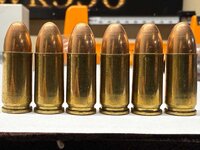
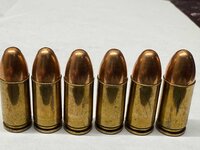
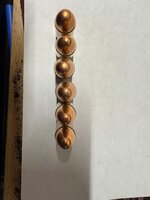
How do these look to you?
 

Attachments

  • IMG_4265.jpeg
    IMG_4265.jpeg
    76.2 KB · Views: 5
  • IMG_4266.jpeg
    IMG_4266.jpeg
    56.4 KB · Views: 5
  • IMG_4268.jpeg
    IMG_4268.jpeg
    33.8 KB · Views: 8
Back
Top Bottom