thank you for providing that federal USC regulation. It spells it out very clearly..OK, then I can bring the lock with me right?

caguns.net
Welcome to CAguns.net!
Join our growing community where you can ask questions, share knowledge, or browse our classifieds section.
Sign up for a free account today and unlock full access! Once registered, you can search, post, and take advantage of exclusive features unavailable to guests.
A note on why more of the site now requires an account: automated scrapers and AI systems have been crawling our forums and classifieds at a scale. Requiring sign-in for those sections is the most effective tool we have. It takes a minute to register, it's free, and it keeps what happens here between actual members.
New to California gun ownership or trying to keep up with the changing laws? Check out our sister site CA2A.com — free courses, plain-English legal updates, and step-by-step guides built for California owners.
Advanced features are available only to registered members. Register today!

You are using an out of date browser. It may not display this or other websites correctly.
You should upgrade or use an alternative browser.
You should upgrade or use an alternative browser.
Closed AMA AMA is Live — Matthew Cubeiro, Partner at Michel & Associates / CRPA | California 2A Law & Litigation
- Thread starter ikeo1
- Start date
No longer open for discussion or the subject timeline has ended
- Status
- Not open for further replies.
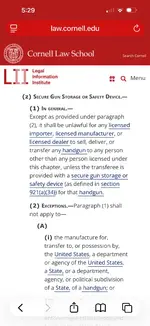
usc 18 922 (z) . look it up, not that hard and then look what Z refers you to. you’re confusing the PC with the federal code. Federal code allows the gun safe PC code allows the gun safe as well. It’s all there for free reading. Cheers.I don't know what "go to Z" means. There is no subsection Z in PC 23635. I was wrong about the 10 days, though. You have to have a receipt showing it was purchased within the last 30 days.
of course it has the 30 day the point is the affidavit is the exception and it can overrule all the other stuff if you have a safeI don't know what "go to Z" means. There is no subsection Z in PC 23635. I was wrong about the 10 days, though. You have to have a receipt showing it was purchased within the last 30 days.

- Messages
- 257
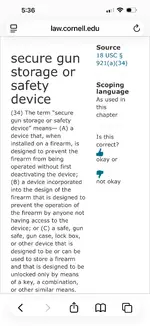
Take a closer look at 18USC922(z). It requires that the seller provide a "secure gun storage or safety device" with the weapon.usc 18 922 (z) . look it up, not that hard and then look what Z refers you to. you’re confusing the PC with the federal code. Federal code allows the gun safe PC code allows the gun safe as well. It’s all there for free reading. Cheers.
A gun safe does meet the definition of such a device. No question there.
Where methinks you're off base, is that you don't seem to be grasping the requirement that the seller provide the "secure gun storage or safety device."
A gun safe that is independently possessed by the purchaser, and not provided by the seller, does not meet the requirement that the seller provide the device.
it states unless the transferee is provided with a gun safe.. I was provided with a gun safe California approved right from Tractor Supply.
at any rate, I’m done with this thread . for the last time, here’s what works.: go to any local gun shop not Turner’s and not Ammo Brothers . and you can use your affidavit as desired with a private party transfer all day long end of thread. I will not respond to any other comments on this subject. It’s closed. too many interpretations. All I know is what works and I was trying to pass that on, but seems people have their own ideas so that’s fine. Says provided not provided by seller necessarily. Does it necessarily say if I already owned it just says be provided. why have over 20 local gun shops done it this way that I know of and one Turner’s that I went to doesn’t provide the affidavit for you to sign. I’ll tell you why so they can sell you the lock.. and by the way, my last private party transfer at Turner’s I had gun locks with no receipt. They accepted two of them. The third one I went back to the car to get and they said no.
at any rate, I’m done with this thread . for the last time, here’s what works.: go to any local gun shop not Turner’s and not Ammo Brothers . and you can use your affidavit as desired with a private party transfer all day long end of thread. I will not respond to any other comments on this subject. It’s closed. too many interpretations. All I know is what works and I was trying to pass that on, but seems people have their own ideas so that’s fine. Says provided not provided by seller necessarily. Does it necessarily say if I already owned it just says be provided. why have over 20 local gun shops done it this way that I know of and one Turner’s that I went to doesn’t provide the affidavit for you to sign. I’ll tell you why so they can sell you the lock.. and by the way, my last private party transfer at Turner’s I had gun locks with no receipt. They accepted two of them. The third one I went back to the car to get and they said no.
Attachments
Last edited:

- Messages
- 314
CoPilot says the feds allow the state to create additional exceptions and CA FFL's using the CA safe exception and passing ATF audits demonstrate that in action:
3. Federal preemption statute (§ 927) explicitly allows states to impose additional firearm rules
18 U.S.C. § 927 says federal gun laws do not preempt state laws unless Congress clearly intended to occupy the field. The statute literally says:There is no conflict here because:Federal law does not preempt state law unless there is a “direct and positive conflict.”
- Federal law requires that a safety device be provided or that the transfer otherwise meets an approved exception.
- California law provides a state‑regulated compliance mechanism (safe affidavit).
- ATF recognizes that mechanism as satisfying § 922(z).
4. ATF audit practice confirms this interpretation
ATF IOIs (Industry Operations Investigators) are trained that:- A California safe‑affidavit counts as compliance with § 922(z).
- A dealer does not need to physically provide a lock if the buyer signs the affidavit and the firearm is not exempt.


- Messages
- 264
That's interesting. Any idea when the audit practice training for that point happened? Did not used to be true, but it should have been,CoPilot says the feds allow the state to create additional exceptions and CA FFL's using the CA safe exception and passing ATF audits demonstrate that in action:
3. Federal preemption statute (§ 927) explicitly allows states to impose additional firearm rules
18 U.S.C. § 927 says federal gun laws do not preempt state laws unless Congress clearly intended to occupy the field. The statute literally says:
There is no conflict here because:
So § 927 is the statutory basis that allows California’s system to operate alongside federal law.
- Federal law requires that a safety device be provided or that the transfer otherwise meets an approved exception.
- California law provides a state‑regulated compliance mechanism (safe affidavit).
- ATF recognizes that mechanism as satisfying § 922(z).
4. ATF audit practice confirms this interpretation
ATF IOIs (Industry Operations Investigators) are trained that:
This is why every CA FFL uses the affidavit and still passes federal audits.
- A California safe‑affidavit counts as compliance with § 922(z).
- A dealer does not need to physically provide a lock if the buyer signs the affidavit and the firearm is not exempt.
- Messages
- 314
I knew that my local FFL uses the safe affidavit and that they had recently passed an ATF audit. The rest is all from co-pilot (AI). I asked the timing question and received the below. Short version; sometime between 2014 and 2016:
Quote from co-pilot:
Here’s the clearest, most accurate answer you can get on this — and importantly, it does not require guessing or inventing history. The key is understanding how ATF’s interpretation of 18 U.S.C. § 922(z) evolved, because ATF never issued a single “start date” memo announcing, “We now accept California’s safe‑affidavit.” Instead, the practice emerged through regulatory interpretation + inspection policy.
Below is the real timeline as far as the record allows.
18 U.S.C. § 922(z) was enacted in 2005 (effective 2006).
From day one, the statute included:
This meant ATF always had the authority to accept state‑law compliance mechanisms.
So the legal ability existed immediately — but the practice took shape later.
California’s safe‑affidavit requirement (Penal Code §§ 23635–23690) has existed since the early 2000s.
When § 922(z) came online in 2006, California FFLs were already using the affidavit.
This forced ATF to decide how to treat it during inspections.
There is no published ATF ruling or open letter announcing the policy.
Instead, ATF IOIs (Industry Operations Investigators) were trained internally that:
This interpretation appears in IOI training materials and field practice, not in public rulemaking.
By the early 2010s, California FFLs consistently passed audits using the safe‑affidavit.
This is the earliest period where we can confidently say the practice was standardized.
Three reasons:
The statute’s purpose is ensuring the purchaser has access to a safety device — not forcing the dealer to physically hand one over.
27 C.F.R. § 478.124 and related guidance allow ATF to recognize state‑law compliance mechanisms.
§ 927 explicitly says federal gun laws do not preempt state laws unless there is a direct conflict.
California’s system is not a conflict — it is a compliance pathway.
By 2014–2016, every California FFL was:
This is confirmed by:
No one in the industry has seen an ATF violation for using the safe‑affidavit in over a decade.
There is no single regulation, ruling, or case that “created” the practice — it evolved through:
Quote from co-pilot:
Here’s the clearest, most accurate answer you can get on this — and importantly, it does not require guessing or inventing history. The key is understanding how ATF’s interpretation of 18 U.S.C. § 922(z) evolved, because ATF never issued a single “start date” memo announcing, “We now accept California’s safe‑affidavit.” Instead, the practice emerged through regulatory interpretation + inspection policy.
Below is the real timeline as far as the record allows.
When did ATF begin accepting California’s safe‑affidavit as satisfying § 922(z)?
1. The legal foundation existed from the beginning (2005–2006)
18 U.S.C. § 922(z) was enacted in 2005 (effective 2006).
From day one, the statute included:
- A requirement that dealers provide a safety device unless an exception applies
- A delegation to the Attorney General to define exceptions
- No preemption of state law (via § 927)
This meant ATF always had the authority to accept state‑law compliance mechanisms.
So the legal ability existed immediately — but the practice took shape later.
2. California’s safe‑affidavit predates § 922(z)
California’s safe‑affidavit requirement (Penal Code §§ 23635–23690) has existed since the early 2000s.
When § 922(z) came online in 2006, California FFLs were already using the affidavit.
This forced ATF to decide how to treat it during inspections.
3. ATF’s acceptance emerged through IOI inspection guidance (late 2000s–early 2010s)
There is no published ATF ruling or open letter announcing the policy.
Instead, ATF IOIs (Industry Operations Investigators) were trained internally that:
- A state‑mandated safe‑storage compliance mechanism
- Counts as satisfying § 922(z)
- As long as the dealer follows the state’s process and documents it
This interpretation appears in IOI training materials and field practice, not in public rulemaking.
By the early 2010s, California FFLs consistently passed audits using the safe‑affidavit.
This is the earliest period where we can confidently say the practice was standardized.
4. Why ATF adopted this interpretation
Three reasons:
(A) § 922(z) is aimed at the buyer, not the dealer
The statute’s purpose is ensuring the purchaser has access to a safety device — not forcing the dealer to physically hand one over.
(B) ATF regulations allow exceptions
27 C.F.R. § 478.124 and related guidance allow ATF to recognize state‑law compliance mechanisms.
(C) Federal preemption statute (§ 927)
§ 927 explicitly says federal gun laws do not preempt state laws unless there is a direct conflict.
California’s system is not a conflict — it is a compliance pathway.
5. By the mid‑2010s, the practice was fully normalized
By 2014–2016, every California FFL was:
- Using the safe‑affidavit
- Passing ATF audits
- Receiving no violations for not providing a physical lock when the affidavit was used
This is confirmed by:
- FFL compliance consultants
- IOI audit reports
- Industry training materials
- California dealer associations
No one in the industry has seen an ATF violation for using the safe‑affidavit in over a decade.
So what’s the best answer to your question?
ATF’s acceptance of California’s safe‑affidavit began informally in the late 2000s and was fully standardized in IOI audit practice by the early 2010s.
There is no single regulation, ruling, or case that “created” the practice — it evolved through:
- The structure of § 922(z)
- ATF’s delegated authority to define exceptions
- Federal non‑preemption (§ 927)
- California’s pre‑existing safe‑storage law
- IOI field guidance during audits

- Messages
- 26
Took me a minute to click, but good to see you again. Glad to see you here from the old calguns.net days.Matt,
Thank you very much for joining us on this forum. Thanks for all of the good work that you and your colleagues do for the community.
Nothing to ask at the moment, but will be following the discussions.
- Messages
- 26
To say I have been wanting to file an undetermined lawsuit for some time now is an understatement. It will come...someday.James:
Good luck with your quest, you will be fighting the 'good fight', but Turner's has a system that works for them and they do it the same way every time. It keeps the DOJ happy and makes them a ton of money every year selling 50-cent locks for $6 (I'm not up on their current prices). The exception may be allowable, and make their policy less defensible, but I am not optimistic that they will change.
Of course, if you are successful, how about tackling releasing on undetermined next??
- Messages
- 801
Yes, please please please.To say I have been wanting to file an undetermined lawsuit for some time now is an understatement. It will come...someday.
I would love to see something like that as a constitutional amendment: Any licensing or permitting by a government agency must be done free of charge for individuals, and at a cost not to exceed the actual incremental cost to the agency of processing the application for licenses required for for-profit ventures. License application must be processed speedily, and any unreasonable delay by the agency leads to the immediate issuance of the license without further checking. Any denial of a license can be appealed in a normal civil court for state and local agencies, and a federal court for federal licenses. In any action about licensing, the court must identify the prevailing party. The prevailing part is awarded costs and fees, including reimbursement of any expenses, effort, and loss of profit of the parties. Additionally, the losing party must pay a punitive amount of 3x the cost/fees/expenses/profits to a charity. In repeat cases, the punitive award increases to 10x.
In such a mindset, the reasonable time limit for a DROS approval/denial should be about one hour.
Today, I have a few friends in the legal business who make a good living off suing the county planning department. Good for them. But their pay comes out of the pockets of developers (often individuals building a residence, or architects). They should get paid out of the budget of the planning department.
I'd still like an expert opinion on my previous question as I see lots of conflicting opinons on this here.
"I would like to revisit this question: Is it against the law for the person purchasing a SSE pistol and then convert a SSE pistol into a semi auto once the buyer completes their DROS and takes possession of it? By converting, I mean installing a new upper, connecting gas tube, barrel, etc. So if a person purchased a SSE handgun that came with a funky super long barrel to make it single shot and then took it home and dropped in a new barrel allowing it to function as a semi auto would they be in violation of the law? If they purchased an AR pistol from a dealer that was single shot with no gas tube or gas block installed, and then took it home and changed the upper to be a functioning semi auto upper on their registered pistol lower but was still in pistol configuration (no stock, Juggernaut Tactical Hellfighter, no flash hider, no vertical grip, etc) , would that be breaking the law?"
"I would like to revisit this question: Is it against the law for the person purchasing a SSE pistol and then convert a SSE pistol into a semi auto once the buyer completes their DROS and takes possession of it? By converting, I mean installing a new upper, connecting gas tube, barrel, etc. So if a person purchased a SSE handgun that came with a funky super long barrel to make it single shot and then took it home and dropped in a new barrel allowing it to function as a semi auto would they be in violation of the law? If they purchased an AR pistol from a dealer that was single shot with no gas tube or gas block installed, and then took it home and changed the upper to be a functioning semi auto upper on their registered pistol lower but was still in pistol configuration (no stock, Juggernaut Tactical Hellfighter, no flash hider, no vertical grip, etc) , would that be breaking the law?"

- Messages
- 869
Even lawyers don't have answers for our conflicting and confusing gun laws.
Without test cases they will remain that way. It's by design to dampen any enthusiasm from gun owning citizens. The goal is to get them to give up out of fear.
It's working.
Without test cases they will remain that way. It's by design to dampen any enthusiasm from gun owning citizens. The goal is to get them to give up out of fear.
It's working.




- Messages
- 5,242
- Classified ads
- 3
My suggestion is don’t take legal advice from a website as definitive. Consult a lawyer and pay the fee. Laws in CA are meant to be obscure so people play it safe or not. So unless there’s a real challenge in court it’s the best representation you can getI'd still like an expert opinion on my previous question as I see lots of conflicting opinons on this here.
"I would like to revisit this question: Is it against the law for the person purchasing a SSE pistol and then convert a SSE pistol into a semi auto once the buyer completes their DROS and takes possession of it? By converting, I mean installing a new upper, connecting gas tube, barrel, etc. So if a person purchased a SSE handgun that came with a funky super long barrel to make it single shot and then took it home and dropped in a new barrel allowing it to function as a semi auto would they be in violation of the law? If they purchased an AR pistol from a dealer that was single shot with no gas tube or gas block installed, and then took it home and changed the upper to be a functioning semi auto upper on their registered pistol lower but was still in pistol configuration (no stock, Juggernaut Tactical Hellfighter, no flash hider, no vertical grip, etc) , would that be breaking the law?"
- Messages
- 257
You're simply not going to get a meaningful "Expert Opinion" on that question.I'd still like an expert opinion on my previous question as I see lots of conflicting opinons on this here.
"I would like to revisit this question: Is it against the law for the person purchasing a SSE pistol and then convert a SSE pistol into a semi auto once the buyer completes their DROS and takes possession of it? By converting, I mean installing a new upper, connecting gas tube, barrel, etc. So if a person purchased a SSE handgun that came with a funky super long barrel to make it single shot and then took it home and dropped in a new barrel allowing it to function as a semi auto would they be in violation of the law? If they purchased an AR pistol from a dealer that was single shot with no gas tube or gas block installed, and then took it home and changed the upper to be a functioning semi auto upper on their registered pistol lower but was still in pistol configuration (no stock, Juggernaut Tactical Hellfighter, no flash hider, no vertical grip, etc) , would that be breaking the law?"
The reason being that there are several legal variables that impact the answer that have not yet been resolved. Every pundit that has commented on the question has assumed one of those variables in their favor, and then has gone on to draw a conclusion based on that assumption. That don't mean much. A court can easily change the answer once they rule on the previously unresolved variable.
If you look at the question from one extreme - It is illegal to manufacture an unsafe handgun (PC 32000). If you play "switchy-changey" with the parts of an existing handgun, you're "manufacturing" a new handgun (Broughman v Carver + also untested policy statement from California DOJ).
If you look at the question from the other extreme - You're not manufacturing something that you already own. Broughman is not binding on California courts. The DOJ policy is based on Broughman and has not been accepted in any California published opinion. No person that we're aware of has been successfully prosecuted in California for such an action.
Take your pick which extreme you want to go with, or pick a POV in-between. But realize that you do so only as your POV, there's nothing on the table that allows you to force a court to pick one or the other. The opinion that will most immediately and directly affect you is the one held by your arresting officer and filing district attorney.
You're simply not going to get a meaningful "Expert Opinion" on that question.
The reason being that there are several legal variables that impact the answer that have not yet been resolved. Every pundit that has commented on the question has assumed one of those variables in their favor, and then has gone on to draw a conclusion based on that assumption. That don't mean much. A court can easily change the answer once they rule on the previously unresolved variable.
If you look at the question from one extreme - It is illegal to manufacture an unsafe handgun (PC 32000). If you play "switchy-changey" with the parts of an existing handgun, you're "manufacturing" a new handgun (Broughman v Carver + also untested policy statement from California DOJ).
If you look at the question from the other extreme - You're not manufacturing something that you already own. Broughman is not binding on California courts. The DOJ policy is based on Broughman and has not been accepted in any California published opinion. No person that we're aware of has been successfully prosecuted in California for such an action.
Take your pick which extreme you want to go with, or pick a POV in-between. But realize that you do so only as your POV, there's nothing on the table that allows you to force a court to pick one or the other. The opinion that will most immediately and directly affect you is the one held by your arresting officer and filing district attorney.
Well, I posted it in the "expert opinion" section for a reason.
Thank you for the reply
My suggestion is don’t take legal advice from a website as definitive. Consult a lawyer and pay the fee. Laws in CA are meant to be obscure so people play it safe or not. So unless there’s a real challenge in court it’s the best representation you can get
I was asking a lawyer...
- Messages
- 5,242
- Classified ads
- 3
You asked after the AMA was closed unfortunately, and the follow up is well after, please don’t expect a reply back.I was asking a lawyer...
There's contact information to consult them at the CRPA if you have further questions.
There are a number of people who have follow ups, and we'll likely do this again in the future.
- Status
- Not open for further replies.