18+ Content Warning

By clicking Enter, you confirm you are 18 years of age or older and agree to comply with all applicable local, state, and federal laws.

Notice: Any content or member activity - including anything you may buy, sell, transfer, or discuss - must comply with current and upcoming laws.

Members are encouraged to stay informed: California Firearm Laws: 2026 Outlook & 2025 Recap . Responsibility for compliance rests solely with the individual member.

caguns.net

Welcome to CAguns.net!
Join our growing community where you can ask questions, share knowledge, or browse our classifieds section.

Sign up for a free account today and unlock full access! Once registered, you can search, post, and take advantage of exclusive features unavailable to guests.

A note on why more of the site now requires an account: automated scrapers and AI systems have been crawling our forums and classifieds at a scale. Requiring sign-in for those sections is the most effective tool we have. It takes a minute to register, it's free, and it keeps what happens here between actual members.

New to California gun ownership or trying to keep up with the changing laws? Check out our sister site CA2A.com — free courses, plain-English legal updates, and step-by-step guides built for California owners.

Advanced features are available only to registered members. Register today!

Who else has done bolt lapping for better precision?

TheAverageShooter

Active member
Messages
136
I got a new Ruger Precision in 6.5CM a short while back. It seems to like Hornady and Berger target ammo, and overall it has been doing well. I saw a few mentions of doing bolt lapping on these to improve accurracy. I tested the bolt on mine and it seemed one lug had good contact, one had some contact and one barely had any contact. Got some lapping compound on Midway and followed the process. Now all 3 lugs have very solid contact. Only took it to the range once since and it seemed to have helped precision somewhat, before it could do 1" 5 shot groups easily with the occasional 0.5" group. After the lapping it seems to do 3/4" groups, with some 0.5" groups and the occasional 1" group, probably good for using factory Hornady/Berger ammo with a factory rifle.

Not sure if it was the lapping or that maybe barrel is now broken in. Just crossed 200 rounds on the last session after lapping. I did notice I gained about 50 fps with the Hornady 147gr and about 30 fps with the 140gr ammo from the initial strings.

Anybody else done this and what was your results?

Still waiting to take it out to longer ranges, as 100yds with it feels like driving a Porsche in 1st gear.
 
I'm not a gunsmith, but I don't think you're going to see any improvements on paper by lapping lugs. The goal is to just even out the bolt face and lug contact with the receiver and if it's that bad where the bolt is not true causing accuracy issues, that's when you have it trued by a gunsmith (somethings referred to as blueprinting).

The only thing you're really going to notice is the smoothness of the lockup and maybe bolt open.

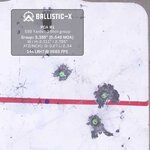
As far as any accuracy gains you're seeing, it's likely just coincidental and small sample sizes. I usually test accuracy by shooting at steel at 400 to 600 yards with a waterline on them (Sharpie'd line horizontally across center) and making sure the POI remains stable in terms of elevation, hopefully well under 1MOA elevation dispersion.

Attached photo is only a 3-shot group, but you get the idea.
 

Attachments

  • 97777894-F972-43A7-B5A1-BD595E59A415.JPG
    97777894-F972-43A7-B5A1-BD595E59A415.JPG
    32.8 KB · Views: 1
While it likely has nothing to do with accuracy, I sort of lapped my fluted bolt on my .308. What I did was I first cleaned and then dried the bolt and the receiver. Then I slathered the bolt and the inside surfaces in the receiver where the bolt runs with a heavy paste of molybdenum disulfide I then installed the bolt and operated the bolt two or three hundred times to make sure all surfaces were well burnished with the moly. Then I wiped off the excess and then lubed, using my regular lube. The difference in smoothness while operating the bolt was remarkable.

I also believe that as long as the bolt is fully closed, it has no effect on accuracy. How could it?
 
If bolt lug contact is bad, lapping them can reduce how quickly accuracy degrades (ie. reduce how fast headspace opens up), but as an immediate effect probably won't affect accuracy.
 
I also believe that as long as the bolt is fully closed, it has no effect on accuracy. How could it?
My understanding is that bolt contact on the receiver can impact the harmonics on the barrel when firing, especially if it is not even on the receiver, and you want consistent harmonics for precision. How true it is in real life is why I started the thread. I have not noticed a huge difference in my results and there are other variables as well, so I dunno. Also not sure if a heavy contour barrel will be less impacted.

This is probably the fastest explanation of it, start around the 1:00 mark in the video.
 
Last edited:
Probably a little more consistent accuracy. Reloading your own ammo would be a bigger improvement.
 
I wonder what Randall has to say about this and if he does this service.
Bolt lapping in an action with a loose bolt fit won't help accuracy at all.
This is because the bolt lugs being uneven is usually caused by the bolt-to-receiver clearance AND the cocking piece forces.
When there is slop, the force of the cocked firing pin cams the bolt body upwards in the receiver.
The excess clearance then causes the top lug lift off.
When you fire, all that camming force goes away and bolt body is free to bounce around in the receiver again.

You need to take away the slop between the bolt and the receiver before bolt lapping will help.
Lapping a sloppy loose bolt into a receiver simply cuts the lugs crooked so that they appear to match better, but the fact that the bolt body is still sloppy loose and then forces of firing will still make the bolt bounce around in the receiver.

When I true an action, I cut the receiver lug abutments square to the bore and use a new oversized bolt body and lap in the lugs but the lapping is really just to prove that the bolt lugs are square on both the bolt and the receiver.

If you have a sloppy bolt fit AND uneven bolt contact, then you are going to get a bolt that jumps in the receiver upon firing.
The slop can be taken out of a factory bolt by welding bumps on the rear of the bolt body to make the bolt fit the reciever at lockup.
It's fine for the bolt to be sloppy loose while you are cycling it but it's best that the bolt not be sloppy fitting during lockup.
I have even put set screws into an action to make the fit of a bolt adjustable so I can tune for the tightest fit at lockup but a looser fit while cycling.

The reason lapping helps after the bolt body fits tightly as it gets all the lugs bearing evenly and now the bolt body does not try to jump around in the receiver when the pressure hits the boltface while the bullet is moving down the barrel.

The biggest concern with lapping an assembled rifle is that you are increasing headspace.
You never do lug lapping on an assembled rifle.
Always lap lugs before taking headspace length measurements for a rebarrel job.
If you lap an assembled gun, then you need to pull the barrel off and set it back into the receiver to take up the excess headspace that you created while lapping.

If you somehow end up with an assembled bolt rifle that has short headspace, you can lap the lugs until a GO headspace gauge will fit properly.
This is commonly done on M1A/M14 type rifles when a barrel is slightly short on headspace and is chrome lined so it can not be rechambered.
 
Last edited:
While it likely has nothing to do with accuracy, I sort of lapped my fluted bolt on my .308. What I did was I first cleaned and then dried the bolt and the receiver. Then I slathered the bolt and the inside surfaces in the receiver where the bolt runs with a heavy paste of molybdenum disulfide I then installed the bolt and operated the bolt two or three hundred times to make sure all surfaces were well burnished with the moly. Then I wiped off the excess and then lubed, using my regular lube. The difference in smoothness while operating the bolt was remarkable.
This was burnishing, not lapping.
Burnishing is to smooth out sharper edges.
Lapping is more than that and is done to make 2 surfaces come into full contact with each other.
 
That’s why I said “sort of lapping”. I later mentioned burnishing. And burnishing is more than taking down sharp edges. In the case I described, I’m burnishing the microfine molybdenum disulfide powder into the microscopic pores of the metal, where it stays, providing the very best lubrication and heat resistance.

And I do a similar treatment of my barrels. I’ll spray the dry powder down the barrel and then put the moly powder on a patch and run it down the barrel. And also on the first few bullets I fire. This works the moly into the barrel itself where it stays.
 
Last edited:
Back
Top Bottom