

- Messages
- 18
I thought I’d share a recent acquisition. Perusing a LGS with a little time to kill, I spotted a sporterized “98 Mauser” with for sale for $450. It was obviously not a Mauser rifle, but a 1903. What caught my eye was the B Nickel optic. I quickly looked up those optics, and saw them running in excess of $400. While it was dirty, it was a complete functioning rifle.
With my 03/COE, I walked out the same day having paid a hair over $400+tax+DROS. I did alert the staff to the erroneous tag so they could DROS it properly.
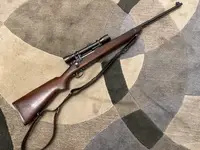
When I took it home and cleaned it up, it was immediately obvious that this, while not a show rifle, was not some bubba job. It has the hallmarks of a professional gunsmithing job from the postwar period.
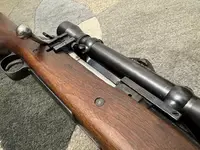
The rifle itself is a perfect example of an interwar ‘03. It’s a 1929 Springfield in the 1.3M range.
It has a highly polished bolt body, left in the white, with a reforged bolt handle to clear the scope. The scope base is extremely low, made by Buehler of Orinda, as is the wing safety. The trigger was serrated and tuned. The barrel is also highly polished, and headspaced very tight, possibly about .001” short. The barrel and receiver are nicely blued.
It also has a Lyman rear sight, but the slider is missing, as it could only fit with the scope removed. The scope is a German optic, with a single dot reticle. It even still has its turret cover. I don’t know much about these optics, so if anyone has Old Gunsights and Rifle Scopes, please PM me; I’d love to get more info.
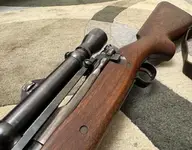
The stock is a cut down C stock, as best I can tell. The barrel band has been reshaped to fit without the hand guard. The buttplate was also replaced with a nice cupped, textured model.
I understand this style of rifle to be a “California” style hunting rifle for taking deer in mountainous, wooded terrain and low light conditions. It is very clearly built with functionality in mind. It also seems to be correct for a custom build in the postwar period.
Unfortunately, there are no obvious gunsmith’s marks other than an R at the root of the bolt handle, which was clearly stamped after the bolt was polished.
This may not be a museum piece, but I think I did pretty well for what I paid. But, again, I’m looking for more information on its provenance and that of the scope. If anyone has reference materials, I’d appreciate more information.
With my 03/COE, I walked out the same day having paid a hair over $400+tax+DROS. I did alert the staff to the erroneous tag so they could DROS it properly.
When I took it home and cleaned it up, it was immediately obvious that this, while not a show rifle, was not some bubba job. It has the hallmarks of a professional gunsmithing job from the postwar period.
The rifle itself is a perfect example of an interwar ‘03. It’s a 1929 Springfield in the 1.3M range.
It has a highly polished bolt body, left in the white, with a reforged bolt handle to clear the scope. The scope base is extremely low, made by Buehler of Orinda, as is the wing safety. The trigger was serrated and tuned. The barrel is also highly polished, and headspaced very tight, possibly about .001” short. The barrel and receiver are nicely blued.
It also has a Lyman rear sight, but the slider is missing, as it could only fit with the scope removed. The scope is a German optic, with a single dot reticle. It even still has its turret cover. I don’t know much about these optics, so if anyone has Old Gunsights and Rifle Scopes, please PM me; I’d love to get more info.
The stock is a cut down C stock, as best I can tell. The barrel band has been reshaped to fit without the hand guard. The buttplate was also replaced with a nice cupped, textured model.
I understand this style of rifle to be a “California” style hunting rifle for taking deer in mountainous, wooded terrain and low light conditions. It is very clearly built with functionality in mind. It also seems to be correct for a custom build in the postwar period.
Unfortunately, there are no obvious gunsmith’s marks other than an R at the root of the bolt handle, which was clearly stamped after the bolt was polished.
This may not be a museum piece, but I think I did pretty well for what I paid. But, again, I’m looking for more information on its provenance and that of the scope. If anyone has reference materials, I’d appreciate more information.
Last edited: